Baloney Inspection Report: Claim #1175 · Inspected Oct 31, 2026, 8:15 AM PDT · Scoring model v2
 24%
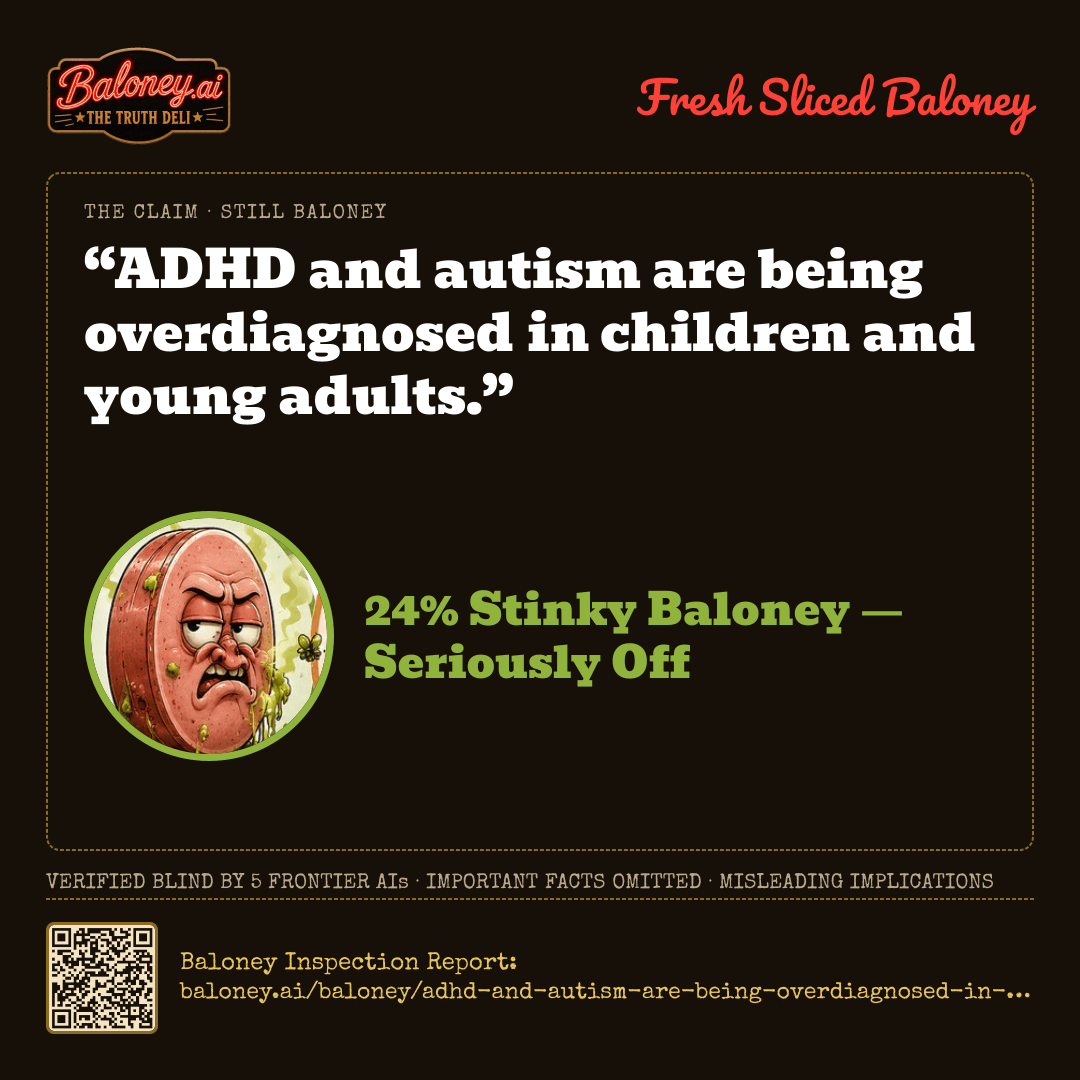
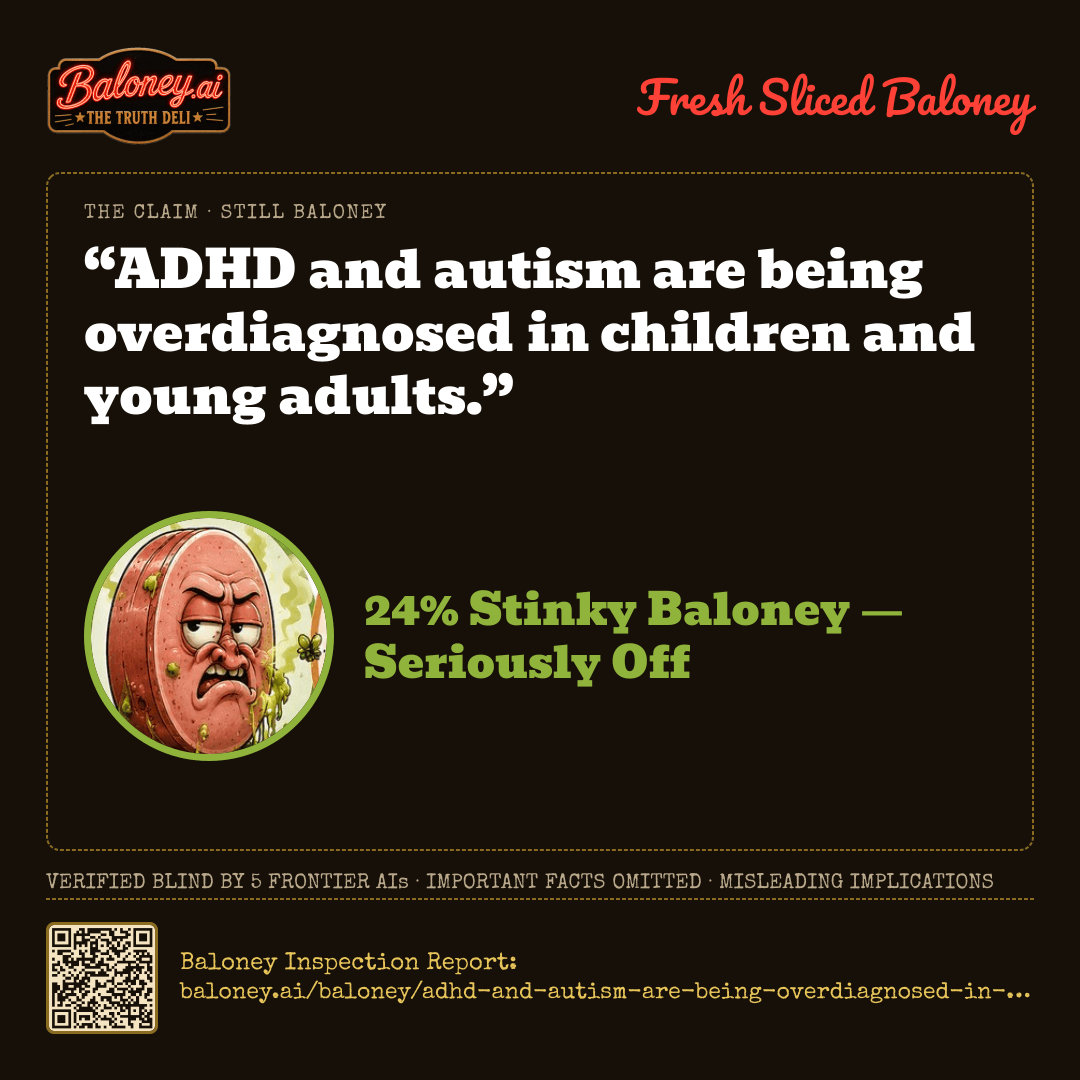
“ADHD and autism are being overdiagnosed in children and young adults.”
24%Stinky Baloney — Seriously Off
That’s not the whole story…
Important facts omittedMisleading implicationsCherry-picked infoSpins the truth
Serve It Fresh
Ready to Serve16 servings
Serve it the way you want it
The Verdict
 “ADHD and autism are being overdiagnosed in children and young adults.”24% Stinky Baloney — Seriously OffVerified blind by 5 frontier AIs · Baloney Inspection Report: baloney.ai/baloney/adhd-and-autism-are-being-overdiagnosed-in-children-and
The Baloney Sampler
The claim that ADHD and autism are broadly overdiagnosed is misleading. Major medical and health bodies, including the U.S. Centers for Disease Control and Prevention and the UK Department of Health and Social Care, attribute rising diagnosis rates largely to better screening, reduced stigma, and the recognition of historically missed groups like girls, adults, and racial minorities. While diagnostic boundaries have broadened, authoritative reviews, such as those from The Lancet, emphasize that systemic underdiagnosis remains a profound issue, with long waiting lists indicating unmet clinical demand.
However, there is evidence of localized overdiagnosis at the margins, particularly for ADHD. Research in the New England Journal of Medicine shows a "relative-age effect," where the youngest children in a classroom are more often diagnosed, suggesting normal immaturity is sometimes medicalized. Reviews in JAMA Network Open also note potential overtreatment of milder ADHD cases. Yet lumping both conditions together and stating widespread overdiagnosis as an established fact ignores the medical consensus that the core issue is changing ascertainment, not an epidemic of false positives.
Resting on U.S. Centers for Disease Control and Prevention · UK Department of Health and Social Care · New England Journal of Medicine · JAMA Network Open
Original Claim Source https://timesofindia.indiatimes.com/etimes/wellness/adhd-and-autism-at-risk-of-over-diagnosis-says-government-review/articleshow/134887050.cms
Other ways to slice it — phrasings that might have changed the rating
- “There is evidence of overdiagnosis and overtreatment of mild ADHD presentations in children.” The JAMA Network Open systematic review and relative-age studies specifically support the localized overdiagnosis of milder ADHD cases and the medicalization of immature children.
- “Reported diagnosis rates for ADHD and autism have risen significantly in recent decades.” CDC surveillance data and UK primary care cohort data confirm that diagnosis counts have increased dramatically, which is the factual statistical basis behind fears of overdiagnosis.
- “ADHD and autism remain systematically underdiagnosed in girls, adults, and racial minorities.” Authoritative bodies emphasize that rising overall rates largely reflect improved detection, reduced stigma, and the necessary closing of historical equity gaps in these specific populations.
Written from the panel’s reports by Google · gemini-3.1-pro-preview. Nothing here changed the score.
The Order Ticket
15:15:12CLAIM RECEIVED — QUEUED FOR INSPECTION✓
15:17:08claude-opus-5 REPORTED — SCORE 30, CONFIDENCE 72✓
15:16:08gpt-5.5 REPORTED — SCORE 24, CONFIDENCE 80✓
15:15:45gemini-3.1-pro-preview REPORTED — SCORE 25, CONFIDENCE 90✓
15:15:18sonar-pro REPORTED — SCORE 18, CONFIDENCE 91✓
15:17:58grok-4.6 REPORTED — SCORE 14, CONFIDENCE 68✓
15:18:58PRIMARY MASTER GEMINI — SCORE 24✓
15:18:29BLIND VALIDATION GROK — SCORE 22✓
15:19:27AGREEMENT CONFIRMED — DELTA 2✓
15:19:27SCORING MODEL V2 — MEDIAN OF 5 COUNTED LAB SCORES: 30, 24, 25, 18, 14 → 24.✓
15:19:27SOURCE RULE — LABS CITED 32 SOURCES: 0 DISCARDED FOR HAVING NO URL, 0 DISCARDED AS DEAD LINKS (404/410), 17 COULD NOT BE OPENED BY US AND ARE MARKED UNVERIFIED.✓
15:19:27SOURCE RULE — PRIMARY MASTER RULED ON 20 SOURCES: 0 DISCARDED FOR HAVING NO URL, 0 DISCARDED AS DEAD LINKS, 11 MARKED UNVERIFIED, 9 VERIFIED.✓
How This One Was Sliced
Station 1 · Blind Inspection — Five Graders, Zero Peeking
Each lab scored the claim independently, without seeing the others. Open a breakdown for its evidence, its sources, and how sure it was.
Anthropic · EQUAL WEIGHT · 115.6s
claude-opus-5
30%BALONEY
ROUND-1 BREAKDOWN
Evidence offered for the claim- A systematic scoping review of 334 studies (Kazda et al., JAMA Network Open, 2021) applied a formal five-question overdiagnosis framework and concluded the evidence is consistent with overdiagnosis and overtreatment of ADHD in children and adolescents, particularly for those with milder symptoms, where harms of labelling and medication may outweigh benefits.
- Relative-age effects provide hard quasi-experimental evidence of diagnostic error: in a US cohort of >400,000 children (Layton et al., NEJM, 2018), children born in August in states with a September 1 school cut-off were about 34% more likely to be diagnosed with and treated for ADHD than children born in September — i.e., normal immaturity is being coded as disorder.
- Population symptom levels have not tracked diagnosis rates. A Swedish twin-register study (Lundström et al., BMJ, 2015) found the prevalence of autism *symptoms* in children was essentially stable over a decade while registered clinical autism diagnoses rose sharply, implicating administrative/diagnostic expansion rather than a real increase in the condition.
- A meta-analysis of 11,000+ participants (Rødgaard, Mottron et al., JAMA Psychiatry, 2019) found effect sizes separating autistic from non-autistic people on cognitive and behavioural measures shrank by roughly 45–80% between 1966 and 2019, consistent with the diagnostic category being progressively broadened to include less distinct cases.
- Diagnosis rates have risen steeply in a short time: US CDC/NSCH data show ADHD diagnoses in children rose to about 11.4% (≈7.1 million) by 2022, and CDC ADDM autism prevalence rose from 1 in 150 (2000 birth-cohort surveillance) to about 1 in 31 eight-year-olds (2022 surveillance year) — increases far faster than any plausible change in underlying biology.
- UK primary-care cohort data (Russell et al., J Child Psychol Psychiatry, 2022) recorded an increase of roughly 787% in recorded autism diagnoses between 1998 and 2018, with the steepest rises in adults and females — a pattern that can reflect either correction of past under-recognition or threshold creep, and that critics read as the latter.
- Wide unexplained variation between countries, states, schools and individual clinicians in diagnosis rates for both conditions indicates that thresholds are being applied inconsistently, which is a recognised marker of diagnostic inflation at the margins.
Evidence against the claim- Community-based prevalence of ADHD (measured by standardised assessment rather than clinical records) has been stable at roughly 5–7% of children for three decades (Polanczyk et al., Int J Epidemiol, 2014); the World Federation of ADHD International Consensus Statement (Faraone et al., 2021) explicitly concludes that ADHD is *not* overdiagnosed as a whole and remains under-identified and undertreated in many countries, with rising diagnosis rates largely closing the gap toward true prevalence.
- Documented underdiagnosis in specific groups cuts directly against a blanket claim: girls and women, adults, people with intellectual disability, and historically Black, Hispanic and low-income children have been systematically diagnosed later or missed, with 'camouflaging' well documented in autistic females.
- Service data suggest unmet, not excess, demand: ADHD and autism assessment waiting lists in the UK run to hundreds of thousands of people with multi-year waits, prompting NHS England to convene an ADHD taskforce; NICE guidance (NG87) continues to warn about under-recognition as well as inappropriate diagnosis.
- Much of the autism increase is attributable to documented non-clinical factors — DSM criteria broadening (DSM-III-R, DSM-IV, DSM-5), diagnostic substitution away from intellectual disability and language disorder labels, mandated school screening, and service-eligibility incentives — which CDC itself cites as explanations for prevalence change rather than evidence that diagnosed children do not have the condition.
- The 2022 ADDM data show roughly 40% of identified autistic 8-year-olds also have intellectual disability and a further large share borderline range, indicating the diagnosed population is not simply an influx of trivially affected children.
- 'Overdiagnosis' has a technical meaning — diagnosing people who cannot benefit — and that is hard to demonstrate for neurodevelopmental conditions: most diagnosed children show functional impairment, and diagnosis is the gateway to educational accommodations and treatment with documented short-term benefit. The Lancet Commission on autism (Lord et al., 2022) frames the central problem as poor access to appropriate, personalised care globally, not surplus diagnosis.
- The scientific literature is genuinely split, and the strongest overdiagnosis findings are qualified: Kazda et al. themselves limit their conclusion to milder cases and call the overall evidence incomplete, while finding no evidence of overdiagnosis in severe presentations. No authoritative body has endorsed the unqualified statement that these conditions are overdiagnosed.
How sure this lab was72/100 — the lab’s own confidence in the score above, not a second reading of the claim.
SourcesJAMA Network Open (Kazda et al., Overdiagnosis of ADHD in Children and Adolescents: A Systematic Scoping Review)journal · 92 · New England Journal of Medicine (Layton et al., ADHD and Month of School Enrollment)journal · 95 · The BMJ (Lundström et al., Autism phenotype versus registered diagnosis in Swedish children)journal · 92 · JAMA Psychiatry (Rødgaard, Mottron et al., Temporal Changes in Effect Sizes of Studies Comparing Individuals With and Without Autism)journal · 90 · Neuroscience & Biobehavioral Reviews (Faraone et al., World Federation of ADHD International Consensus Statement)journal · 88 · International Journal of Epidemiology (Polanczyk et al., ADHD prevalence estimates across three decades)journal · 88 · The Lancet (Lord et al., Lancet Commission on the future of care and clinical research in autism)journal · 90 · Journal of Child Psychology and Psychiatry (Russell et al., Time trends in autism diagnosis over 20 years)journal · 85 · Journal of Clinical Child & Adolescent Psychology (Danielson et al., ADHD prevalence among U.S. children and adolescents in 2022)journal · 85 · U.S. Centers for Disease Control and Prevention — Autism Data and Statistics (ADDM Network)gov · 92 · U.S. Centers for Disease Control and Prevention — ADHD Data and Statisticsgov · 92 · National Institute for Health and Care Excellence (UK), Guideline NG87: ADHD diagnosis and managementgov · 90
OpenAI · EQUAL WEIGHT · 55.3s
gpt-5.5
24%BALONEY
ROUND-1 BREAKDOWN
Evidence offered for the claim- Diagnosed prevalence has risen rapidly, which is compatible with at least some overdiagnosis: CDC reports ADHD diagnosis among U.S. children has increased, and CDC ADDM surveillance reports autism prevalence among 8-year-olds rising to about 1 in 31 in 2022. Rising prevalence alone does not prove overdiagnosis, but it is a key reason the concern exists.
- For ADHD specifically, a JAMA Network Open systematic scoping review concluded there is evidence consistent with overdiagnosis and overtreatment in children and adolescents, especially identification of milder/borderline cases that may receive labels and medication without clear net benefit.
- ADHD diagnoses show a relative-age effect: children who are among the youngest in their school grade are more likely to be diagnosed and treated for ADHD than older classmates, suggesting some normal immaturity may be medicalized as ADHD.
- For autism, part of the apparent prevalence increase is attributable to changing diagnostic/reporting practices rather than a true increase in underlying incidence. JAMA Pediatrics research in Denmark estimated that changes in reporting practices explained a large share of the observed increase, and a JAMA Psychiatry meta-analysis found decreasing measured differences between autistic and non-autistic groups over time, consistent with broadened diagnostic boundaries.
Evidence against the claim- The claim overstates what the evidence can show. Increased diagnosis is not the same as overdiagnosis: it can reflect better screening, broader awareness, reduced stigma, improved access to evaluations, and recognition of previously missed groups.
- Autism evidence is weaker than ADHD evidence. Diagnostic broadening and substitution show that prevalence statistics changed, but they do not by themselves prove that children or young adults are being incorrectly diagnosed.
- Underdiagnosis and delayed diagnosis still coexist with possible overdiagnosis. CDC autism surveillance emphasizes the importance of early identification and shows substantial variation by site and demographic group, indicating access and ascertainment differences rather than a simple nationwide pattern of excessive diagnosis.
- For ADHD, professional guidelines require symptoms causing impairment in more than one setting and evaluation for alternative explanations. Poor-quality or borderline diagnoses occur, but guideline-concordant diagnosis is intended to avoid labeling normal childhood behavior as ADHD.
- The statement lumps together ADHD and autism and applies broadly to children and young adults. The strongest evidence supports possible ADHD overdiagnosis in specific contexts, while autism data more strongly support changing recognition and criteria, with both overdiagnosis and underdiagnosis possible depending on population and setting.
How sure this lab was80/100 — the lab’s own confidence in the score above, not a second reading of the claim.
SourcesJAMA Network Openjournal · 92 · BMJjournal · 91 · Centers for Disease Control and Preventiongov · 90 · American Academy of Pediatrics / Pediatricsjournal · 91 · Centers for Disease Control and Preventiongov · 90 · CDC Morbidity and Mortality Weekly Reportgov · 90 · JAMA Pediatricsjournal · 92 · JAMA Psychiatryjournal · 90
Google · EQUAL WEIGHT · 32.6s
gemini-3.1-pro-preview
25%BALONEY
ROUND-1 BREAKDOWN
Evidence offered for the claim- A 2021 systematic scoping review published in JAMA Network Open found convincing evidence of ADHD overdiagnosis in children and adolescents, warning that mild symptoms are increasingly medicalized, leading to unnecessary interventions.
- Studies consistently demonstrate a 'relative age effect' in ADHD diagnoses. Children who are the youngest in their classroom cohort are significantly more likely to be diagnosed and medicated than their oldest peers, suggesting that normal developmental immaturity is sometimes being pathologized.
- For autism, some researchers argue that the broadening of diagnostic criteria (such as the transition to the DSM-5) has led to 'diagnostic inflation,' wherein individuals with very mild traits are labeled with ASD, blurring the boundaries between neurodivergence and typical development.
Evidence against the claim- The broader medical consensus attributes much of the rising prevalence in both ADHD and ASD to improved screening tools, reduced stigma, better public awareness, and the deliberate broadening of criteria to capture individuals who were historically missed, rather than false positives.
- Blanket claims of overdiagnosis obscure the profound, systemic underdiagnosis of both conditions in specific demographics, particularly girls, adult women, and racial or ethnic minorities, whose symptoms often present differently or are heavily masked.
- Recent CDC data indicates that the rising rates of autism reflect a closing of historical equity gaps. For example, recent reports show Black and Hispanic children being identified at rates comparable to or slightly higher than White children for the first time, suggesting better access to diagnosis rather than overdiagnosis.
How sure this lab was90/100 — the lab’s own confidence in the score above, not a second reading of the claim.
SourcesJAMA Network Openjournal · 95 · New England Journal of Medicinejournal · 95 · Centers for Disease Control and Prevention (CDC)gov · 98
Perplexity · EQUAL WEIGHT · 5.4s
sonar-pro
18%BALONEY
ROUND-1 BREAKDOWN
Evidence offered for the claim- Diagnosis rates and referrals for ADHD and autism have risen sharply, while available epidemiological evidence suggests that underlying population prevalence has remained broadly stable. This divergence supports concern about possible misdiagnosis or overdiagnosis, particularly among adolescents and young adults.[2][5]
- A UK government review found that recorded diagnoses in some younger age groups now exceed older population-prevalence estimates and warned that the risk of misdiagnosis and overdiagnosis is becoming increasingly important.[2]
- The government review reported sharply rising diagnosis and referral activity, especially among adolescent and young adult females, despite no dramatic increase in estimated underlying ADHD prevalence.[5]
Evidence against the claim- The UK government review explicitly concluded that available evidence cannot establish overdiagnosis occurring at scale, partly because population-prevalence data and reporting are incomplete.[2]
- Rising diagnosis rates can reflect improved recognition of people previously missed, including girls and women, older people, and minoritized groups; experts cited by the Science Media Centre said autism and ADHD remain substantially underdiagnosed in several populations.[3]
- CDC surveillance documents increasing identified autism prevalence but does not establish that those diagnoses are inappropriate; diagnosis counts alone cannot distinguish genuine improved detection from overdiagnosis.[1][7]
- The evidence concerns different conditions, age groups, and health systems, so the broad statement that ADHD and autism are being overdiagnosed in children and young adults overgeneralizes a risk that has not been demonstrated consistently or at population scale.[2][3]
How sure this lab was91/100 — the lab’s own confidence in the score above, not a second reading of the claim.
SourcesUK Department of Health and Social Caregov · 97 · UK Department of Health and Social Caregov · 97 · Science Media Centreother · 88 · U.S. Centers for Disease Control and Preventiongov · 98 · U.S. Centers for Disease Control and Preventiongov · 98 · ITV Newsnews · 85
xAI · EQUAL WEIGHT · 165.6s
grok-4.6
14%BALONEY
ROUND-1 BREAKDOWN
Evidence offered for the claim- CDC data document sharp rises in identified prevalence (ADHD reaching ~11% of US children; autism 1 in 36 among 8-year-olds), increases too large and rapid to be explained solely by a true biological epidemic.
- Large geographic, racial/ethnic, and socioeconomic variation in diagnosis rates is more consistent with differing diagnostic thresholds, awareness, and incentives than with uniform underlying prevalence.
- Broadened criteria (especially autism spectrum including milder presentations), routine screening, school accommodations (IEPs/504 plans), and access to stimulants create incentives to label borderline, overlapping, or environmentally driven symptoms.
- Clinician reports, re-evaluation studies, and diagnostic-substitution research show some children and young adults receive ADHD or autism labels for typical developmental variation, sleep/trauma/anxiety issues, or other conditions.
Evidence against the claim- Much of the recorded increase reflects improved detection, reduced stigma, universal screening recommendations, and capture of previously missed cases (especially girls, milder presentations, and historically underserved groups).
- Both conditions show high heritability, replicated neurobiological correlates, and clear functional impairment in many diagnosed individuals; major medical bodies treat rising identification as a service need rather than primarily artifact.
- Documented historical underdiagnosis means current rates may be approaching, not exceeding, true prevalence in some populations; adult/young-adult ADHD diagnoses partly correct childhood misses.
- Treatment and educational supports produce measurable benefits for a substantial fraction of those diagnosed, inconsistent with a claim that most labels are false positives.
How sure this lab was68/100 — the lab’s own confidence in the score above, not a second reading of the claim.
SourcesCDCgov · 95 · NIMHgov · 92 · CDCgov · 90
Station 2 · The Masters
Primary Master · drawn at random
gemini-3.1-pro-preview
24% BALONEY
The statement frames a complex, nuanced clinical debate as an unqualified fact. While there is credible evidence of diagnostic threshold creep and localized overdiagnosis of milder ADHD cases (such as the relative-age effect), an overarching claim of broad 'overdiagnosis' is misleading. The surge in diagnostic rates for both ADHD and autism is primarily attributed by medical consensus to improved screening, broadened clinical criteria, and the critical recognition of previously missed populations, including girls, adults, and racial minorities. Because many of these groups remain systematically underdiagnosed, a blanket assertion of overdiagnosis omits crucial context.
All evaluators acknowledged that rapid increases in ADHD and autism diagnosis rates have raised legitimate scholarly questions about potential overdiagnosis. They uniformly agreed on specific phenomena, such as the 'relative age effect' in ADHD and the broadening of diagnostic boundaries for autism. However, all five evaluators emphasized that the blanket statement overgeneralizes, noting that much of the diagnostic increase reflects improved detection of historically missed demographics rather than widespread inappropriate medicalization.
Blind Validation Master · never saw the Primary’s work
grok-4.6
22% BALONEY
The claim as written is an unqualified assertion that both conditions are being overdiagnosed in children and young adults. The reports document real supporting evidence: diagnosis rates have risen far faster than measured symptom prevalence; a systematic scoping review found evidence consistent with ADHD overdiagnosis/overtreatment especially in milder cases; relative-age effects show some normal immaturity being labelled ADHD; autism diagnostic boundaries have broadened (shrinking case-control effect sizes; reporting-practice changes explaining much of the rise). That evidence makes a weaker, qualified version of the claim (some overdiagnosis at the margins, especially ADHD) defensible. It does not make the statement as written true. Authoritative sources in the reports (UK independent review, World Federation of ADHD consensus, Lancet Commission, CDC framing) do not conclude overdiagnosis at scale; they treat much of the increase as improved detection, reduced stigma, criteria change, and closing of historical gaps (girls, adults, racial/ethnic minorities). Underdiagnosis and multi-year waiting lists coexist with any overdiagnosis. Autism evidence is weaker than ADHD evidence and is more about ascertainment and substitution than proven false positives. Lumping both conditions and all children/young adults together, and stating overdiagnosis as established fact, omits those caveats and implies a settled excess of false positives that the cited evidence does not support.
AGREEMENT TEST PASSED — MASTERS SCORED 24% AND 22% · BLIND VALIDATION CONFIRMED THIS SCORE · NO RE-EVALUATION REQUIRED
How the number was reached · scoring model v2 · how our models work
- Median of 5 counted lab scores: 30, 24, 25, 18, 14 → 24.
The Evidence
Evidence offered for the claim
- Surging diagnosis rates DEBUNKED — Diagnosis rates for both conditions have risen steeply in recent decades. However, rising rates do not inherently prove overdiagnosis, as they heavily reflect improved detection, universal screening, and the overdue recognition of previously under-diagnosed populations.
- Relative-age effects in ADHD Studies consistently show children who are the youngest in their school cohort are significantly more likely to be diagnosed and treated for ADHD than their oldest classmates, providing strong quasi-experimental evidence that normal developmental immaturity is sometimes medicalized.
- Diagnostic boundaries have broadened Meta-analyses demonstrate that the effect sizes separating autistic from non-autistic individuals on cognitive and behavioral measures have shrunk over the decades, suggesting the diagnostic category has progressively widened to include less distinct, milder cases.
Evidence against the claim
- Populations remain heavily underdiagnosed A blanket claim of overdiagnosis obscures the systemic under-recognition of girls, women, adults, and racial or ethnic minorities, many of whom have been historically missed because their symptoms present differently or are heavily masked.
- Community prevalence of ADHD is stable Standardized community assessments over three decades show the true underlying prevalence of ADHD has remained broadly stable at 5–7%, indicating that rising clinical diagnosis rates are largely closing the gap toward true prevalence rather than inflating it.
- Diagnoses provide necessary support 'Overdiagnosis' technically means diagnosing people who cannot benefit from the label. Yet, the vast majority of diagnosed children show significant functional impairment and experience documented benefits from educational accommodations and tailored treatments.
Sources · Reliability · Why Accepted or Discounted
Every link was opened when this claim was inspected. A dead link was discarded before publication; “unverified” means the site refused our automated check and the link is the one the panel cited. A source without a URL was never kept.
Serve It Fresh
Ready to Serve16 servings
Serve it the way you want it
The Verdict
“ADHD and autism are being overdiagnosed in children and young adults.”24% Stinky Baloney — Seriously OffVerified blind by 5 frontier AIs · Baloney Inspection Report: baloney.ai/baloney/adhd-and-autism-are-being-overdiagnosed-in-children-and