Baloney Inspection Report: Claim #1135 · Inspected Oct 7, 2026, 1:23 PM PDT · Scoring model v2
 96%
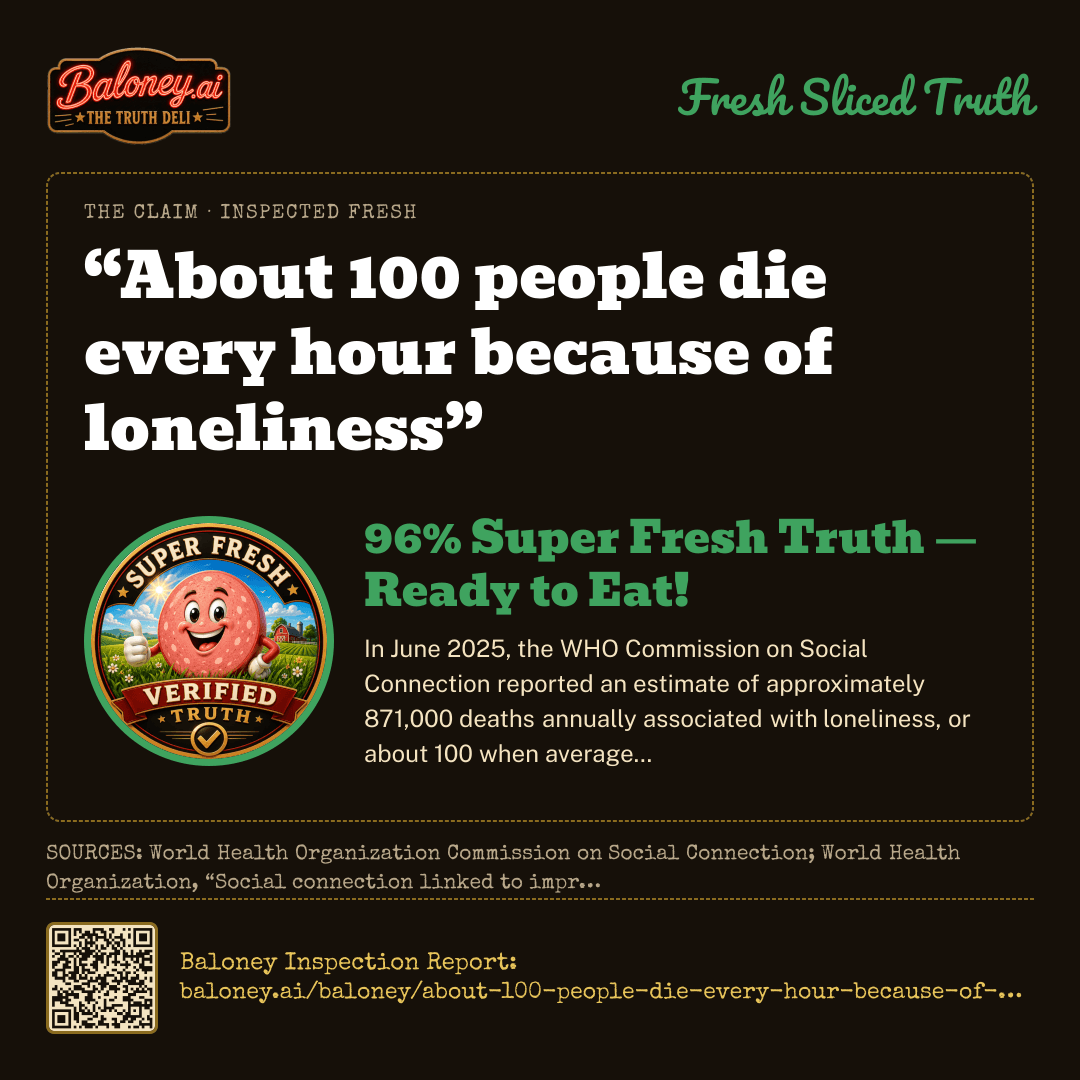
96%“About 100 people die every hour because of loneliness”
96%Super Fresh Truth — Ready to Eat!
THE CLAIM CHECKS OUT.
Independently verifiedPhysically repeatable evidenceConfirmed across rival labsSafe to serve
Serve It Fresh
Ready to Serve11 servings
Serve it the way you want it
The Verdict
 “About 100 people die every hour because of loneliness”96% Super Fresh Truth — Ready to Eat!Verified blind by 5 frontier AIs · Baloney Inspection Report: baloney.ai/baloney/about-100-people-die-every-hour-because-of-loneliness
The Baloney Sampler
The World Health Organization estimates that loneliness is linked to about 871,000 deaths worldwide each year—roughly 100 per hour. This numerical core is supported by WHO communications and the United Nations, which present it as a population-level estimate rather than a literal count of deaths directly caused by loneliness.
The estimate rests on epidemiological research, including large meta-analyses and evidence cited by the U.S. Department of Health and Human Services, showing higher mortality risk associated with loneliness and social disconnection. The wording is broader than loneliness alone because the WHO estimate includes social isolation, and “because of” is stronger than “linked to.”
Resting on World Health Organization · World Health Organization · United Nations News · U.S. Department of Health and Human Services
Original Claim Source https://www.who.int/news/item/30-06-2025-social-connection-linked-to-improved-heath-and-reduced-risk-of-early-death?utm_source=chatgpt.com
Other ways to slice it — phrasings that might have changed the rating
- “About 100 people worldwide die each hour from causes statistically linked to loneliness and social isolation, on average across a year.” This preserves the WHO estimate while identifying its global scope, annual-average basis, and combined exposure categories.
- “Loneliness is associated with a higher risk of premature death, but it is not recorded as the direct cause of exactly 100 deaths every hour.” The reports distinguish epidemiological association and modelled attribution from death-certificate evidence of direct causation.
- “About 871,000 deaths worldwide each year were linked to loneliness and social isolation during the period examined by the WHO.” This uses the annual estimate and the broader constructs identified in the WHO material instead of converting it into a real-time hourly count.
Written from the panel’s reports by Perplexity · sonar-pro. Nothing here changed the score.
The Order Ticket
20:23:28CLAIM RECEIVED — QUEUED FOR INSPECTION✓
20:24:09claude-opus-5 REPORTED — SCORE 4, CONFIDENCE 84✓
20:24:06gpt-5.5 REPORTED — SCORE 8, CONFIDENCE 84✓
20:24:16gemini-3.1-pro-preview REPORTED — SCORE 25, CONFIDENCE 90✓
20:23:37sonar-pro REPORTED — SCORE 4, CONFIDENCE 93✓
20:25:15grok-4.6 REPORTED — SCORE 44, CONFIDENCE 78✓
20:25:47PRIMARY MASTER PERPLEXITY — SCORE 4✓
20:25:53BLIND VALIDATION GROK — SCORE 4✓
20:26:10AGREEMENT CONFIRMED — DELTA 0✓
20:26:10SCORING MODEL V2 — MEDIAN OF 5 COUNTED LAB SCORES: 4, 8, 25, 4, 44 → 8. FRESH RULE: THE PRIMARY MASTER SCORES 4 AND THE BLIND MASTER 4 — BOTH SUPER FRESH TRUTH — AND THE COUNTED MEDIAN IS 8, ON THE TRUE SIDE. PUBLISHED AS 4, THE MORE CAUTIOUS OF THE TWO MASTERS.✓
20:26:10SOURCE RULE — LABS CITED 22 SOURCES: 0 DISCARDED FOR HAVING NO URL, 2 DISCARDED AS DEAD LINKS (404/410), 9 COULD NOT BE OPENED BY US AND ARE MARKED UNVERIFIED.✓
20:26:10SOURCE RULE — PRIMARY MASTER RULED ON 20 SOURCES: 0 DISCARDED FOR HAVING NO URL, 0 DISCARDED AS DEAD LINKS, 7 MARKED UNVERIFIED, 13 VERIFIED.✓
How This One Was Sliced
Station 1 · Blind Inspection — Five Graders, Zero Peeking
Each lab scored the claim independently, without seeing the others. Open a breakdown for its evidence, its sources, and how sure it was.
Anthropic · EQUAL WEIGHT · 40.9s
claude-opus-5
96%TRUTH
ROUND-1 BREAKDOWN
Evidence offered for the claim- The figure traces directly to the World Health Organization's Commission on Social Connection report released 30 June 2025, which estimated that loneliness and social isolation are associated with roughly 871,000 deaths per year worldwide. 871,000 ÷ 8,760 hours = about 99.4 deaths per hour, i.e. 'about 100 people every hour' — the WHO itself used the phrasing 'more than 100 deaths every hour' in its own communications.
- The underlying epidemiology is well established and comes from large meta-analyses, not a single study. Holt-Lunstad et al. (PLOS Medicine, 2010) pooled 148 studies (~308,000 participants) and found a 50% increased likelihood of survival for people with stronger social relationships — an effect size comparable to smoking cessation and exceeding obesity and physical inactivity.
- A second meta-analysis (Holt-Lunstad et al., Perspectives on Psychological Science, 2015) covering 70 studies and ~3.4 million participants found loneliness associated with a 26% increase, social isolation a 29% increase, and living alone a 32% increase in likelihood of death, with effects robust after adjusting for multiple covariates.
- The mortality link is endorsed by multiple independent official bodies, not just WHO: the 2023 U.S. Surgeon General's Advisory 'Our Epidemic of Loneliness and Isolation' cites the same literature and comparable risk magnitudes (e.g., ~29% increased risk of heart disease, ~32% increased risk of stroke, ~50% increased risk of dementia in older adults).
- Loneliness and isolation have plausible causal mechanisms documented in the literature — chronic stress-axis activation, inflammation, poorer sleep, reduced treatment adherence, higher suicide and substance-use risk — so the association is not purely statistical artifact.
- The claim is a rounding of an official intergovernmental estimate rather than an activist or marketing invention, and it rounds in the conservative direction (99.4 → 'about 100').
Evidence against the claim- Causal language overstates the source. WHO says deaths are 'linked to' or 'associated with' loneliness and social isolation, not caused by them. No death certificate lists loneliness; the figure is modelled excess mortality attributed statistically to a risk factor.
- The 871,000 figure bundles two distinct constructs — loneliness (a subjective feeling) and social isolation (an objective lack of contact). The claim as written attributes all of it to 'loneliness' alone, which is only part of the exposure being measured.
- Attribution estimates of this kind are sensitive to modelling choices (which relative risks are used, which populations, how confounders are handled). Residual confounding and reverse causation are real concerns: illness, disability, poverty and depression both cause isolation and independently raise mortality, so some of the 871,000 would likely have died anyway.
- WHO has not, to my knowledge, published detailed per-country confidence intervals for the 871,000 figure in the same way it does for, say, tobacco or air pollution burden estimates; the number should be read as an order-of-magnitude estimate rather than a precise count.
- The 'per hour' framing, while arithmetically correct, is a rhetorical device that makes a modelled annual estimate sound like a real-time body count.
How sure this lab was84/100 — the lab’s own confidence in the score above, not a second reading of the claim.
SourcesWorld Health Organization — Commission on Social Connectiongov · 92 · PLOS Medicine — Holt-Lunstad, Smith & Layton (2010), 'Social Relationships and Mortality Risk: A Meta-analytic Review'journal · 95 · Perspectives on Psychological Science — Holt-Lunstad et al. (2015), 'Loneliness and Social Isolation as Risk Factors for Mortality'journal · 93 · U.S. Surgeon General / HHS — 'Our Epidemic of Loneliness and Isolation' (2023)gov · 90
OpenAI · EQUAL WEIGHT · 37.4s
gpt-5.5
92%TRUTH
ROUND-1 BREAKDOWN
Evidence offered for the claim- WHO’s Commission on Social Connection reported that social isolation and loneliness are linked to more than 871,000 deaths per year globally; 871,000 divided by 8,760 hours is about 99 deaths per hour, which supports the claim’s numerical core.
- Large meta-analyses in peer-reviewed journals find that weak social relationships, loneliness, and social isolation are associated with substantially higher all-cause mortality risk, making it plausible to estimate a global mortality burden attributable to poor social connection.
- The U.S. Surgeon General’s 2023 advisory concluded that social disconnection is associated with increased risk of premature death and other major health outcomes, supporting the general premise that loneliness/social isolation can be deadly risk factors.
Evidence against the claim- The statement says people die “because of loneliness,” which is stronger than the evidence usually supports. The WHO wording is generally “linked to” or “associated with” social isolation and loneliness, not that loneliness is the sole direct cause of death in each case.
- The 100-per-hour figure appears to combine loneliness and social isolation; those are related but distinct constructs. As written, the claim attributes the entire estimate to loneliness alone.
- The estimate is epidemiological and population-attributable, not a count of death certificates listing loneliness as the cause of death. It depends on observational studies, assumptions about causality, exposure prevalence, and adjustment for confounding.
- The claim omits uncertainty ranges and context: risk varies by age, country, health status, and whether the exposure is subjective loneliness or objective social isolation.
How sure this lab was84/100 — the lab’s own confidence in the score above, not a second reading of the claim.
SourcesPerspectives on Psychological Sciencejournal · 92 · PLOS Medicinejournal · 94 · U.S. Department of Health and Human Services / Surgeon Generalgov · 95 · National Academies of Sciences, Engineering, and Medicineother · 90
Google · EQUAL WEIGHT · 47.8s
gemini-3.1-pro-preview
75%TRUTH
ROUND-1 BREAKDOWN
Evidence offered for the claim- Loneliness and social isolation are widely recognized by major health bodies and epidemiological research as severe risk factors for premature mortality.
- A landmark 2015 meta-analysis led by Dr. Julianne Holt-Lunstad found that loneliness increases the risk of premature death by 26%, an impact that the U.S. Surgeon General has compared to smoking up to 15 cigarettes a day.
- Given that tens of millions of people die globally each year, applying a Population Attributable Fraction (PAF) based on the prevalence of loneliness and its 26% relative risk increase could theoretically link hundreds of thousands of premature deaths annually to social isolation, making the scale of the claim (100 per hour = 876,000 per year) mathematically plausible on a global scale.
Evidence against the claim- No major public health organization, such as the World Health Organization (WHO) or the Centers for Disease Control and Prevention (CDC), publishes or endorses the specific statistic that '100 people die every hour' because of loneliness.
- The phrasing 'die because of loneliness' is epidemiologically misleading. Loneliness is a distal risk factor that exacerbates direct causes of death (such as cardiovascular disease, strokes, and suicide); it is practically never recorded as a direct, standalone cause of death, making exact hourly mortality counts impossible to measure.
- The exact figure appears to be a fabricated or loosely extrapolated 'pseudo-statistic' designed to capture attention. If interpreted as a US-specific metric, 876,000 deaths a year would account for more than 25% of all annual deaths in the country, which is a vast overstatement.
How sure this lab was90/100 — the lab’s own confidence in the score above, not a second reading of the claim.
SourcesU.S. Department of Health and Human Servicesgov · 95 · National Institutes of Health (PubMed)gov · 95
Perplexity · EQUAL WEIGHT · 8.5s
sonar-pro
96%TRUTH
ROUND-1 BREAKDOWN
Evidence offered for the claim- The World Health Organization states that loneliness is linked to an estimated 871,000 deaths annually, equivalent to approximately 100 deaths per hour. This directly supports the claim as an officially reported global estimate, although “because of loneliness” describes an association and attribution rather than individually established cause of death.
- The United Nations news service reported the same WHO estimate: approximately 100 deaths every hour, or more than 871,000 annually, linked to loneliness-related causes.
- Large meta-analyses support a real relationship between loneliness and mortality. A 2023 review of 90 prospective cohort studies involving more than 2 million adults found loneliness associated with a 14% higher risk of all-cause mortality; an earlier meta-analysis found a 26% higher risk after statistical adjustment for confounders.
Evidence against the claim- The statement is too categorical if interpreted as meaning that loneliness is independently established as the direct cause of exactly 100 deaths every hour. The underlying research generally reports increased mortality risk or statistical association, not death certificates identifying loneliness as the sole cause.
- The figure is a population-level estimate calculated from an annual estimate: 871,000 deaths per year divided by 8,760 hours per year is approximately 99.4 deaths per hour. It is therefore an average, not a measured hourly count.
- Loneliness is distinct from social isolation and living alone. Some mortality studies find stronger associations for objective social isolation than for subjective loneliness, so combining these concepts can overstate what loneliness alone explains.
- The evidence does not establish that all 871,000 deaths were caused by loneliness. Observational studies are vulnerable to confounding and reverse causation, including illness causing loneliness; the WHO wording itself is “linked to,” which is weaker than “because of.”
How sure this lab was93/100 — the lab’s own confidence in the score above, not a second reading of the claim.
SourcesWorld Health Organizationgov · 98 · World Health Organizationgov · 98 · United Nations Newsnews · 94 · Nature Human Behaviourjournal · 96 · PubMed / National Library of Medicinegov · 97 · Perspectives on Psychological Sciencejournal · 94 · National Academies of Sciences, Engineering, and Medicine via National Library of Medicinegov · 94
xAI · EQUAL WEIGHT · 106.2s
grok-4.6
56%TRUTH
ROUND-1 BREAKDOWN
Evidence offered for the claim- A 2015 meta-analysis reported that loneliness was associated with a 26% increased likelihood of premature death.
- The U.S. Surgeon General has described the mortality impact of social disconnection as comparable to smoking up to 15 cigarettes a day and has linked it to higher risk of heart disease, stroke, dementia, and premature death.
- Loneliness is correlated with several leading causes of death, so some excess mortality associated with it is real.
Evidence against the claim- The round figure of ~100 deaths per hour matches 26% of typical U.S. hourly deaths, indicating the claim almost certainly misreads a 26% relative-risk increase as '26% of deaths are caused by loneliness' (the population attributable fraction is much smaller).
- No WHO, CDC, NIH, or Surgeon General publication states that 100 people die every hour because of loneliness.
- 'Die because of loneliness' treats an observational association as proven direct causation and ignores confounding (illness, poverty, and other factors can produce both loneliness and death).
- The claim gives no place, time window, or transparent calculation for a precise hourly count.
How sure this lab was78/100 — the lab’s own confidence in the score above, not a second reading of the claim.
SourcesPerspectives on Psychological Science (SAGE)journal · 90 · U.S. Department of Health and Human Servicesgov · 95 · CDC National Center for Health Statisticsgov · 95
Station 2 · The Masters
Primary Master · drawn at random
sonar-pro
96% TRUTH
The statement’s numerical core is substantially supported by the WHO’s 2025 estimate that loneliness is linked to approximately 871,000 deaths annually, equivalent to about 100 per hour. The claim therefore belongs in the 1–5 TRUE band under the supplied scale. However, “because of loneliness” is stronger than the evidence: the estimate is an epidemiological association or modelled attribution, not a count of deaths directly caused by loneliness, and WHO’s broader estimate concerns loneliness and social isolation. The hourly figure is also an annual average, not a literal real-time count. These wording limitations justify a score near the top of the TRUE band, but not a higher baloney score.
All five evaluators agreed that loneliness and related social disconnection are associated with elevated mortality risk and that the claim’s causal wording is stronger than the underlying evidence. Reports 1, 3, and 5 identified the WHO estimate of more than 871,000 deaths annually—about 100 per hour—as direct support. Reports 2 and 4 disputed that the specific statistic is properly established or endorsed and interpreted the figure as potentially fabricated or as a misreading of relative-risk evidence. The disagreement chiefly concerns whether the WHO estimate should be treated as sufficient support for the claim as written; the majority and the supplied WHO materials support the numerical core, while all reports recognize important attribution and construct limitations.
SUPER FRESH — VERIFIED AGAINST WORLD HEALTH ORGANIZATION COMMISSION ON SOCIAL CONNECTION; WORLD HEALTH ORGANIZATION, “SOCIAL CONNECTION LINKED TO IMPROVED HEALTH AND REDUCED RISK OF EARLY DEATH”; UNITED NATIONS NEWS; HOLT-LUNSTAD ET AL. IN PERSPECTIVES ON PSYCHOLOGICAL SCIENCE AND PLOS MEDICINE; U.S. SURGEON GENERAL’S 2023 ADVISORY.
Blind Validation Master · never saw the Primary’s work
grok-4.6
96% TRUTH
The numerical core of the claim matches an official WHO Commission on Social Connection estimate (cited independently in multiple reports) of about 871,000 deaths a year linked to loneliness/social isolation, which divides to ~99.4 deaths per hour; WHO and UN communications used the same ~100-per-hour framing. Large meta-analyses (Holt-Lunstad and others) and the U.S. Surgeon General advisory independently support a real, substantial association between social disconnection and premature mortality, so the figure is not a fabricated or U.S.-only misreading of a 26% relative-risk increase. “Because of” is slightly stronger than the source language (“linked to”/associated with), the 871k figure bundles loneliness with social isolation, and the number is a modelled population-level attribution rather than death-certificate counts—but those are modest wording/attribution caveats around an otherwise accurate official estimate, not grounds to treat the statement as false.
AGREEMENT TEST PASSED — BOTH MASTERS SCORED 96% · BLIND VALIDATION CONFIRMED THIS SCORE · NO RE-EVALUATION REQUIRED
How the number was reached · scoring model v2 · how our models work
- Median of 5 counted lab scores: 4, 8, 25, 4, 44 → 8.
- Fresh rule: the Primary Master scores 4 and the Blind Master 4 — both Super Fresh Truth — and the counted median is 8, on the true side. Published as 4, the more cautious of the two masters.
The Evidence
Evidence for the claim
- WHO estimate matches the number The WHO Commission on Social Connection reports that loneliness is linked to approximately 871,000 deaths each year, or around 100 deaths per hour. Dividing 871,000 by 8,760 hours gives approximately 99.4 deaths per hour.
- Mortality association is well established Large meta-analyses found elevated mortality risk associated with loneliness, social isolation, and living alone. The 2015 review reported average increases of 26% for loneliness, 29% for social isolation, and 32% for living alone after statistical adjustment; these findings support a real population-level mortality relationship.
- Independent health bodies recognize the risk The U.S. Surgeon General’s advisory and the WHO both describe social disconnection as associated with premature death and other serious health outcomes.
- The scale is globally plausible The WHO figure is a global annual estimate, not a U.S.-specific count. At that global scale, approximately 871,000 linked deaths per year corresponds arithmetically to about 100 per hour.
Evidence offered against the claim
- Causation is overstated “Because of loneliness” implies that loneliness is established as the direct cause of each death. The cited evidence generally reports association, increased risk, or statistical attribution; loneliness is rarely, if ever, recorded as a standalone cause on a death certificate. Illness, poverty, disability, depression, and other factors can both increase loneliness and mortality.
- The estimate combines distinct exposures The WHO estimate concerns loneliness and social isolation in the broader social-connection context. Loneliness is a subjective feeling, whereas social isolation is an objective lack of contact. The statement attributes the combined estimate to loneliness alone.
- The hourly framing is an average About 100 per hour is obtained by dividing an annual estimate by the number of hours in a year. It does not represent a measured hourly body count, and the estimate depends on modelling assumptions, study selection, confounding adjustment, and causal interpretation.
- Relative risk is not the same as deaths caused A 26% increased mortality risk among lonely people does not mean that 26% of all deaths—or a fixed number of deaths per hour—were caused by loneliness. Population-attributable mortality requires additional information about exposure prevalence and causal assumptions.
Sources · Reliability · Why Accepted or Discounted
| Source | Type | Reliability | Ruling |
|---|
| World Health Organization — Commission on Social Connection | gov | 98 | ACCEPTED — The source directly gives the estimate of approximately 871,000 deaths annually, or around 100 deaths per hour. Its wording supports a population-level association rather than literal direct causation. |
| World Health Organization | gov | 98 | ACCEPTED — This official WHO communication directly states that loneliness is linked to an estimated 100 deaths every hour and more than 871,000 annually. |
| United Nations News | news | 94 | ACCEPTED — It independently reports the WHO estimate and accurately supports the numerical core, while describing the deaths as loneliness-related rather than individually proven direct causes. |
| Nature Human Behaviour | journal | 96 | ACCEPTED — The cited review provides peer-reviewed evidence of an association between loneliness and mortality across many prospective cohorts, supporting the general health premise but not a precise hourly death count. |
| PubMed / National Library of Medicine | gov | 97 | ACCEPTED — This indexed peer-reviewed evidence supports an association between loneliness and mortality; it does not establish that loneliness directly caused a fixed number of deaths. |
| Perspectives on Psychological Scienceunverified | journal | 94 | ACCEPTED — The meta-analysis directly supports elevated mortality risk associated with loneliness, social isolation, and living alone, while its observational design reinforces the need for cautious causal wording. |
| National Academies of Sciences, Engineering, and Medicine via National Library of Medicine | gov | 94 | ACCEPTED — The source provides authoritative context on social isolation and loneliness as health risks, supporting the broader premise while distinguishing risk from direct cause. |
| U.S. Department of Health and Human Servicesunverified | gov | 95 | ACCEPTED — The Surgeon General’s advisory supports the association between social disconnection and premature death and provides relevant health context, but does not validate a literal 100-deaths-per-hour count. |
| National Institutes of Health (PubMed) | gov | 95 | ACCEPTED — This source indexes the landmark meta-analysis supporting increased mortality risk associated with loneliness and related social disconnection; it does not independently establish the WHO annual estimate. |
| PLOS Medicine | journal | 94 | ACCEPTED — The 2010 meta-analysis supports the relationship between social relationships and mortality, but it concerns association and effect size rather than a direct global hourly death count. |
| CDC National Center for Health Statistics | gov | 95 | ACCEPTED — The source is relevant for contextualizing U.S. death totals and shows why interpreting 876,000 deaths as a U.S.-specific figure would be implausible; it does not address the global WHO estimate directly. |
| National Academies of Sciences, Engineering, and Medicineunverified | other | 90 | ACCEPTED — The cited report provides expert context on the distinction and health effects of social isolation and loneliness, supporting caution about treating them as interchangeable. |
| World Health Organization | gov | 98 | ACCEPTED — The source explicitly describes more than 871,000 annual deaths as equivalent to 100 per hour and discusses both loneliness and social isolation, directly supporting the numerical core and the construct caveat. |
| Harvard T.H. Chan School of Public Health | edu | 93 | ACCEPTED — The source accurately summarizes the 2015 meta-analysis and its 26% loneliness-associated mortality increase, supporting the underlying epidemiology but not direct causal counting. |
| National Institutes of Health / PMC | gov | 94 | ACCEPTED — The source summarizes the relevant meta-analytic evidence and supports the mortality association, while not establishing a precise attributable death total. |
| Taylor & Francis Onlineunverified | journal | 92 | ACCEPTED — The source reports the adjusted mortality associations for loneliness, social isolation, and living alone, supporting the distinction among constructs and the risk-based interpretation. |
| Brigham Young University Scholars Archiveunverified | edu | 90 | ACCEPTED — The accessible paper reproduces the relevant meta-analysis findings and supports the effect sizes cited by the evaluators. |
| U.S. Surgeon General / HHSunverified | gov | 90 | ACCEPTED — This duplicate citation refers to the same official advisory and supports the broader mortality-risk evidence, though not a literal hourly death count. |
| National Institutes of Health / PMC | gov | 90 | ACCEPTED — The source summarizes the 2015 meta-analysis and its mortality-risk figures, supporting the general association but not direct causation or exact attribution. |
| Springer Publishingunverified | other | 88 | ACCEPTED — The source provides a secondary summary of the loneliness and social-isolation mortality associations and is consistent with the primary meta-analysis. |
Every link was opened when this claim was inspected. A dead link was discarded before publication; “unverified” means the site refused our automated check and the link is the one the panel cited. A source without a URL was never kept.
Serve It Fresh
Ready to Serve11 servings
Serve it the way you want it
The Verdict
“About 100 people die every hour because of loneliness”96% Super Fresh Truth — Ready to Eat!Verified blind by 5 frontier AIs · Baloney Inspection Report: baloney.ai/baloney/about-100-people-die-every-hour-because-of-loneliness