Station 1 · Blind Inspection — Five Graders, Zero Peeking
Each lab scored the claim independently, without seeing the others. Open a breakdown for its evidence, its sources, and how sure it was.
Anthropic · EQUAL WEIGHT · 50.4s
claude-opus-5
38%BALONEY
ROUND-1 BREAKDOWN
Evidence offered for the claim
Large prospective cohorts find vegetarians and vegans have lower rates of ischaemic heart disease: EPIC-Oxford reported ~22% lower IHD risk in vegetarians (including vegans) vs meat eaters over 18 years of follow-up.
Adventist Health Study-2 (~73,000 participants) found vegetarian dietary patterns, including vegan, associated with lower all-cause mortality compared with non-vegetarians, with the strongest associations in men.
Meta-analyses of observational studies (e.g., Dinu et al., 2017) report vegan and vegetarian diets are associated with lower BMI, lower total and LDL cholesterol, lower blood pressure, lower incidence of ischaemic heart disease, and lower total cancer incidence.
A 2023 randomized controlled trial in genetically identical twins (Stanford, Landry et al., JAMA Network Open) found the vegan arm had significantly lower LDL-C, fasting insulin, and body weight after 8 weeks versus a healthy omnivorous diet — reducing confounding from genetics and shared upbringing.
IARC/WHO classifies processed meat as Group 1 carcinogenic to humans and red meat as Group 2A (probably carcinogenic); a vegan diet eliminates these exposures entirely.
Well-planned vegan diets are judged nutritionally adequate for all life stages, including pregnancy, lactation, infancy and athletics, by the Academy of Nutrition and Dietetics — so health benefits need not come with a nutritional penalty if planned properly.
Environmental and indirectly human-health-relevant benefits are large: Poore & Nemecek (Science, 2018) estimated that avoiding meat and dairy could cut an individual's food-related land use by ~76% and greenhouse gas emissions by ~49%, relevant to climate-driven health harms.
Fibre, legume, whole-grain, nut and polyphenol intakes are typically higher on vegan diets, all of which are independently associated with reduced cardiometabolic risk.
Evidence against the claim
The claim is unfalsifiably vague: 'better' is undefined (better for cardiovascular risk? longevity? bone health? athletic performance? all individuals?) and 'better than what' is unspecified — a vegan diet compared to a typical Western diet is not the same comparison as against a Mediterranean or healthy omnivorous diet.
The same EPIC-Oxford cohort that found lower heart disease risk also found vegetarians/vegans had a ~20% higher rate of total stroke, driven mainly by haemorrhagic stroke.
EPIC-Oxford also found vegans had substantially higher risk of total fractures (~43% higher) and of hip, leg and vertebral fractures, partly but not fully explained by lower BMI and lower calcium/protein intake.
Vitamin B12 deficiency is common in unsupplemented vegans; B12 is not reliably available from plant foods, and deficiency can cause irreversible neurological damage. Supplementation or fortification is mandatory, not optional — meaning the diet is not self-sufficient.
Other nutrients of concern requiring active management: long-chain omega-3s (EPA/DHA), iron (non-heme, lower bioavailability), zinc, iodine, calcium, vitamin D, and in some populations choline and selenium.
Vegan is not synonymous with healthy: Satija et al. (JACC, 2017) showed that an 'unhealthful' plant-based diet high in refined grains, sugar-sweetened beverages and sweets was associated with HIGHER coronary heart disease risk. Ultra-processed vegan products can be high in sodium, saturated fat and refined starch.
Most supporting evidence is observational and subject to healthy-user bias: vegetarians and vegans in these cohorts smoke less, drink less, exercise more and are more health-conscious; residual confounding is likely and effect sizes are probably overstated.
Long-term RCT evidence on hard endpoints (mortality, myocardial infarction) for veganism specifically does not exist; trials such as the twin study are short (8–12 weeks) and use surrogate biomarkers.
Several national nutrition bodies (e.g., the German Nutrition Society) do not recommend vegan diets for pregnancy, lactation, infancy, childhood or adolescence without medical supervision and supplementation, citing deficiency risk.
Individual variation matters: people with certain malabsorption conditions, eating disorder histories, some gastrointestinal diseases, or limited access to fortified foods and supplements may fare worse, and there is evidence of higher rates of restrictive-eating behaviour in some vegan subgroups.
Adherence and food-environment constraints reduce real-world effectiveness; benefits observed in motivated cohort members may not generalize to the general population.
How sure this lab was
74/100 — the lab’s own confidence in the score above, not a second reading of the claim.
Well-planned vegan diets can be nutritionally adequate and are associated with lower risk factors for chronic disease; the Academy of Nutrition and Dietetics states that appropriately planned vegetarian, including vegan, diets are healthful, nutritionally adequate, and suitable for all life stages.
Systematic-review evidence links vegetarian/vegan diets with lower body mass index, lower total and LDL cholesterol, lower glucose, and lower rates of ischemic heart disease and some cancers compared with omnivorous diets, though much of this evidence is observational.
In EPIC-Oxford, vegetarians, including some vegans, had lower ischemic heart disease risk than meat eaters, supporting a cardiovascular advantage for plant-based patterns in at least some populations.
A vegan diet typically eliminates red and processed meat and can be higher in fiber, legumes, nuts, fruits, and vegetables, dietary shifts that generally align with major public-health guidance for reducing cardiometabolic risk.
Evidence against the claim
The claim is too broad: a vegan diet is not automatically 'better' for every human; benefits depend on diet quality, supplementation, life stage, medical conditions, access to fortified foods, and comparison diet.
Vitamin B12 is not naturally present in meaningful amounts in plant foods; vegans need reliable fortified foods or supplements, and deficiency can cause anemia and neurologic harm.
EPIC-Oxford found vegetarians, including some vegans, had lower ischemic heart disease risk but higher total stroke risk than meat eaters, complicating a simple 'better' conclusion.
EPIC-Oxford fracture research found vegans had higher risks of total, hip, leg, and other-site fractures than meat eaters, partly associated with lower calcium/protein intake and lower BMI.
Vegan diets can be nutritionally inadequate if poorly planned, with potential concerns including vitamin B12, vitamin D, iodine, calcium, iron, zinc, and omega-3 fatty acids; vegan junk-food diets may be high in refined carbohydrates, salt, and saturated fat from tropical oils.
Much of the human-health evidence comparing vegan and omnivorous diets is observational, so confounding by smoking, exercise, income, body weight, and overall health-conscious behavior limits causal certainty.
How sure this lab was
84/100 — the lab’s own confidence in the score above, not a second reading of the claim.
Well-planned vegan diets are associated with significantly lower risks of cardiovascular disease, hypertension, type 2 diabetes, and certain types of cancer compared to typical Western diets.
Plant-based diets generally lead to lower Body Mass Index (BMI) and improved long-term weight management.
The Academy of Nutrition and Dietetics states that appropriately planned vegan diets are healthful, nutritionally adequate, and may provide health benefits for the prevention and treatment of certain diseases at all stages of life.
Vegan diets have a substantially lower environmental footprint (reducing greenhouse gas emissions, water usage, and land degradation), which indirectly supports human health by mitigating climate change and preserving ecological stability.
Evidence against the claim
Vegan diets entirely lack natural, highly bioavailable sources of Vitamin B12, requiring mandatory supplementation or fortified foods to prevent irreversible neurological damage and anemia.
If not meticulously planned, strict vegan diets carry a higher risk of deficiencies in iron, calcium, iodine, zinc, and omega-3 fatty acids (EPA and DHA).
The claim is framed as an absolute, but comparative studies frequently show that other well-balanced diets containing some animal products (like the Mediterranean or pescatarian diets) offer comparable health outcomes and longevity without the need for strict supplementation.
The rise of highly processed 'vegan junk food' means a vegan diet can still be high in refined sugars, unhealthy fats, and sodium, demonstrating that merely excluding animal products does not guarantee better health.
How sure this lab was
95/100 — the lab’s own confidence in the score above, not a second reading of the claim.
Systematic reviews and meta-analyses report that vegan or plant-based diets are associated with lower body weight, BMI, LDL cholesterol, HbA1c, total cholesterol, and systemic inflammation, especially in short- to medium-term trials and in people with overweight or type 2 diabetes.
Observational meta-analyses have found reduced risk of ischemic heart disease and some cancers among vegetarian/vegan eaters compared with nonvegetarians.
A well-planned vegan diet can be nutritionally adequate for many adults if key nutrients are intentionally supplied, and reviews note benefits in cardiometabolic markers when diets are properly implemented.
Evidence against the claim
Vegan diets can be lower in vitamin B12, vitamin D, iodine, calcium, zinc, selenium, and protein, creating a real risk of deficiency without supplementation or careful planning.
Evidence for broad long-term superiority on hard outcomes like all-cause mortality is inconsistent; some reviews find no significant association for overall cardiovascular disease, cerebrovascular disease, or all-cause mortality.
Some claimed benefits come from observational studies, which cannot fully separate diet effects from other healthy behaviors such as lower smoking rates, higher exercise, or lower overall calorie intake among vegans.
How sure this lab was
83/100 — the lab’s own confidence in the score above, not a second reading of the claim.
Major dietetic bodies state that appropriately planned vegan diets are nutritionally adequate across life stages and are associated with lower rates of ischemic heart disease, type 2 diabetes, hypertension, and some cancers versus typical Western omnivorous patterns.
Plant-forward eating typically increases fiber, unsaturated fats, and phytochemicals while reducing saturated fat and heme iron, which tracks with improved cardiometabolic markers in observational cohorts and some trials.
U.S. Dietary Guidelines include a healthy vegetarian-style pattern as one of several recommended eating patterns.
Evidence against the claim
The claim is absolute and unspecified (better than which diet, for which outcomes, in which people); poorly planned vegan diets commonly produce B12, iodine, iron, zinc, calcium, and long-chain omega-3 shortfalls with clinical consequences.
Large prospective data (e.g., EPIC-Oxford) show elevated fracture risk in vegans; bone, muscle, and pregnancy outcomes require extra planning that many people do not follow.
Observational advantages are heavily confounded by overall lifestyle; ultra-processed vegan products can be as unhealthy as other junk food; suitability is individual and not universally superior to well-constructed omnivorous or pescatarian diets.
How sure this lab was
68/100 — the lab’s own confidence in the score above, not a second reading of the claim.
All five evaluators agree that a **well‑planned vegan diet can be healthful and often confers cardiometabolic advantages compared with typical Western meat‑heavy diets**, and that major dietetic bodies judge it nutritionally adequate when key nutrients are supplemented or obtained from fortified foods. At the same time, they are nearly unanimous that the statement as written — “A vegan diet is better for humans” — is **overly broad and absolute**, ignores important risks of nutrient deficiencies and bone health, and fails to specify “better than what” or for which outcomes and populations. Several reports emphasize that other high‑quality omnivorous or pescatarian patterns (e.g., Mediterranean diets) yield similar health outcomes without mandatory supplementation, and that much of the supporting evidence is observational and confounded. Given this combination of genuine benefits plus significant caveats and the claim’s sweeping, unqualified framing, the panel’s consensus places it in the “Rotting Baloney” band: containing substantial truth about potential health benefits, but misleading as a universal claim that vegan diets are categorically better for all humans in all contexts.
The evaluators broadly agree that vegan diets, when well planned, are nutritionally adequate and associated with lower risks of ischemic heart disease, type 2 diabetes, and some cancers compared with typical Western diets, but they also agree that the claim is too absolute, that poorly planned vegan diets pose real deficiency and fracture risks, and that evidence does not show clear overall superiority to all well‑constructed omnivorous or pescatarian diets.
Blind Validation Master · never saw the Primary’s work
grok-4.6
40% BALONEY
The claim as written is an unspecified absolute (better than what, for which outcomes, for which people) and therefore does not check out. Reports consistently show well-planned vegan patterns can be nutritionally adequate with fortification/supplementation and are associated with better cardiometabolic markers, lower IHD risk, lower BMI, and lower some-cancer incidence versus typical Western omnivorous diets; AND/Academy statements and some trials (including a short twin RCT) support adequacy and biomarker benefits when quality is high. Those advantages are real but heavily qualified: B12 is not supplied by plants and deficiency is clinically harmful; EPIC-Oxford and related data show higher fracture risk and a stroke signal; protein, calcium, iodine, iron, zinc, EPA/DHA and vitamin D require active management; unhealthful/ultra-processed vegan diets can raise CHD risk; observational associations are confounded by lifestyle; long-term RCTs on hard endpoints are lacking; and well-constructed Mediterranean, pescatarian or omnivorous patterns often match or exceed outcomes without the same supplementation burden. Individual, life-stage and access constraints further prevent a universal ranking. The net picture is mixed and context-dependent, not a general superiority of vegan diets for humans.
AGREEMENT TEST PASSED — MASTERS SCORED 44% AND 40% · BLIND VALIDATION CONFIRMED THIS SCORE · NO RE-EVALUATION REQUIRED
The Evidence
Evidence offered for the claim
Major dietetic bodies endorse well‑planned vegan diets The Academy of Nutrition and Dietetics and other national guidelines state that appropriately planned vegan or vegetarian diets are healthful, nutritionally adequate, and suitable across life stages, including pregnancy, lactation, infancy, childhood, adolescence, and athletics, when key nutrients are managed.
Lower cardiometabolic risk markers Systematic reviews and meta‑analyses report that vegan and vegetarian diets are associated with lower BMI, total and LDL cholesterol, blood pressure, HbA1c, fasting insulin, and systemic inflammation, particularly in people with overweight or type 2 diabetes and in short‑ to medium‑term trials.
Reduced ischemic heart disease and some cancers Large cohorts such as EPIC‑Oxford and meta‑analyses (e.g., Dinu et al.) show that vegetarian/vegan patterns are linked to lower incidence of ischemic heart disease and some cancers compared with meat‑eating patterns, though most of this evidence is observational.
Prospective mortality benefits in some populations Adventist Health Study‑2 found that vegetarian diets, including vegan, were associated with lower all‑cause mortality than non‑vegetarian diets, with particularly strong associations among men.
Twin randomized trial showing short‑term advantages A 2023 randomized controlled trial in genetically identical twins (Landry et al.) found that a vegan diet produced significantly lower LDL cholesterol, fasting insulin, and body weight over eight weeks compared with a healthy omnivorous diet, reducing genetic and upbringing confounding.
Elimination of processed and red meat exposure Vegan diets remove processed meat and red meat, which IARC/WHO classify respectively as carcinogenic (Group 1) and probably carcinogenic (Group 2A), thereby eliminating these specific exposures.
Higher intake of protective plant foods Vegan diets are typically higher in fiber, legumes, whole grains, nuts, fruits, vegetables, and polyphenol‑rich foods, all independently associated with reduced cardiometabolic risk and aligned with public‑health dietary guidance.
Environmental and indirect health benefits Analyses such as Poore & Nemecek estimate that avoiding meat and dairy can substantially reduce food‑related land use and greenhouse‑gas emissions, lowering environmental impacts that indirectly support human health through climate and ecosystem stability.
Evidence against the claim
Claim is overly absolute and vague All evaluators note that saying “a vegan diet is better for humans” fails to specify the comparison diet, health outcomes, life stages, or individual conditions, and wrongly implies universal superiority across all contexts.
Mandatory vitamin B12 and other nutrient management Vitamin B12 is not naturally present in meaningful, highly bioavailable amounts in plant foods, so unsupplemented vegans are at real risk of deficiency leading to anemia and neurologic damage; other nutrients of concern include vitamin D, iodine, calcium, iron, zinc, selenium, long‑chain omega‑3s (EPA/DHA), and sometimes choline, requiring careful planning or fortified foods.
Higher fracture risk in vegans EPIC‑Oxford fracture analyses show vegans have substantially higher risks of total, hip, leg, vertebral, and other‑site fractures than meat eaters, partly associated with lower calcium and protein intake and lower BMI, indicating that bone health can be worse on typical real‑world vegan diets without targeted care.
Mixed stroke and mortality outcomes In EPIC‑Oxford, vegetarians and vegans had lower ischemic heart disease risk but higher total stroke risk, mainly haemorrhagic stroke, and some reviews report no clear advantage for overall cardiovascular disease, cerebrovascular disease, or all‑cause mortality, undermining a simple ‘better for humans’ conclusion.
Observational evidence and healthy‑user bias Much of the comparative health evidence for vegan diets is observational; vegetarians and vegans in these cohorts tend to smoke less, drink less, exercise more, and be more health‑conscious, so residual confounding likely inflates apparent benefits, and long‑term randomized trials on hard endpoints are lacking.
Vegan is not synonymous with healthy Satija et al. distinguish healthful from unhealthful plant‑based diets; an unhealthful pattern high in refined grains, sweets, and sugar‑sweetened beverages was associated with higher coronary heart disease risk, and ultra‑processed vegan products can be rich in sodium, saturated fats (e.g., tropical oils), and refined starch, showing that simply excluding animal products does not guarantee better health.
Not recommended for all life stages by all bodies Some national nutrition societies, such as the German Nutrition Society, do not recommend strict vegan diets for pregnancy, lactation, infancy, childhood, or adolescence without medical supervision and supplementation because of the elevated deficiency risk in these groups.
Individual variation and adherence challenges People with specific medical conditions, malabsorption issues, eating‑disorder histories, or limited access to fortified foods and supplements may fare worse on vegan diets, and real‑world adherence and food‑environment constraints mean benefits observed in motivated research cohorts may not generalize to the broader population.
Comparable outcomes from well‑balanced omnivorous patterns Several evaluators note that well‑balanced omnivorous or pescatarian diets, such as Mediterranean‑style patterns that include modest amounts of fish and other animal products, often show similar cardiometabolic and longevity benefits without the need for strict supplementation, so vegan diets are not categorically better for all humans.
Sources · Reliability · Why Accepted or Discounted
ACCEPTED — Peer‑reviewed position paper from the leading U.S. dietetic organization, repeatedly cited across reports for statements on adequacy and potential benefits of vegetarian and vegan diets.
ACCEPTED — High‑quality peer‑reviewed journal publishing large prospective cohort analyses on fracture risk and cardiovascular outcomes that multiple evaluators rely on.
ACCEPTED — Major medical journal with rigorous review standards; provides primary data on differing risks of ischemic heart disease and stroke among diet groups.
ACCEPTED — Peer‑reviewed meta‑analysis synthesizing observational evidence on vegetarian and vegan diets; appropriate for summarizing associations though subject to typical limitations of observational data.
ACCEPTED — Established nutrition journals providing systematic reviews and trials on cardiometabolic markers in plant‑based diets; used to support claims about BMI, cholesterol, and glycemic control.
ACCEPTED — Leading medical journal referenced for planetary‑health and diet‑related environmental impacts; supports environmental and indirect human‑health arguments.
ACCEPTED — U.S. government resource on nutrient requirements and deficiency risks; used for information on B12, vitamin D, iodine, and other nutrients of concern in vegan diets.
ACCEPTED — International cancer research agency providing authoritative classifications of processed and red meat carcinogenicity, relevant to exposures avoided in vegan diets.
ACCEPTED — Official U.S. dietary guidelines that include healthy vegetarian‑style patterns and emphasize plant‑rich eating; supports claims about the acceptability of plant‑forward diets.
ACCEPTED — High‑impact journal article quantifying the environmental footprint of different foods; accepted for environmental and indirect health implications of avoiding animal products.
ACCEPTED — Cardiology journal article distinguishing healthful and unhealthful plant‑based diet indices and their associations with coronary heart disease; supports the point that not all vegan diets are beneficial.
ACCEPTED — Professional nutrition bodies’ position statements cited to show that some authorities advise caution or supervision for vegan diets in sensitive life stages.
Serve It Fresh
Ready to Serve17 servings
Serve it the way you want it
The Verdict
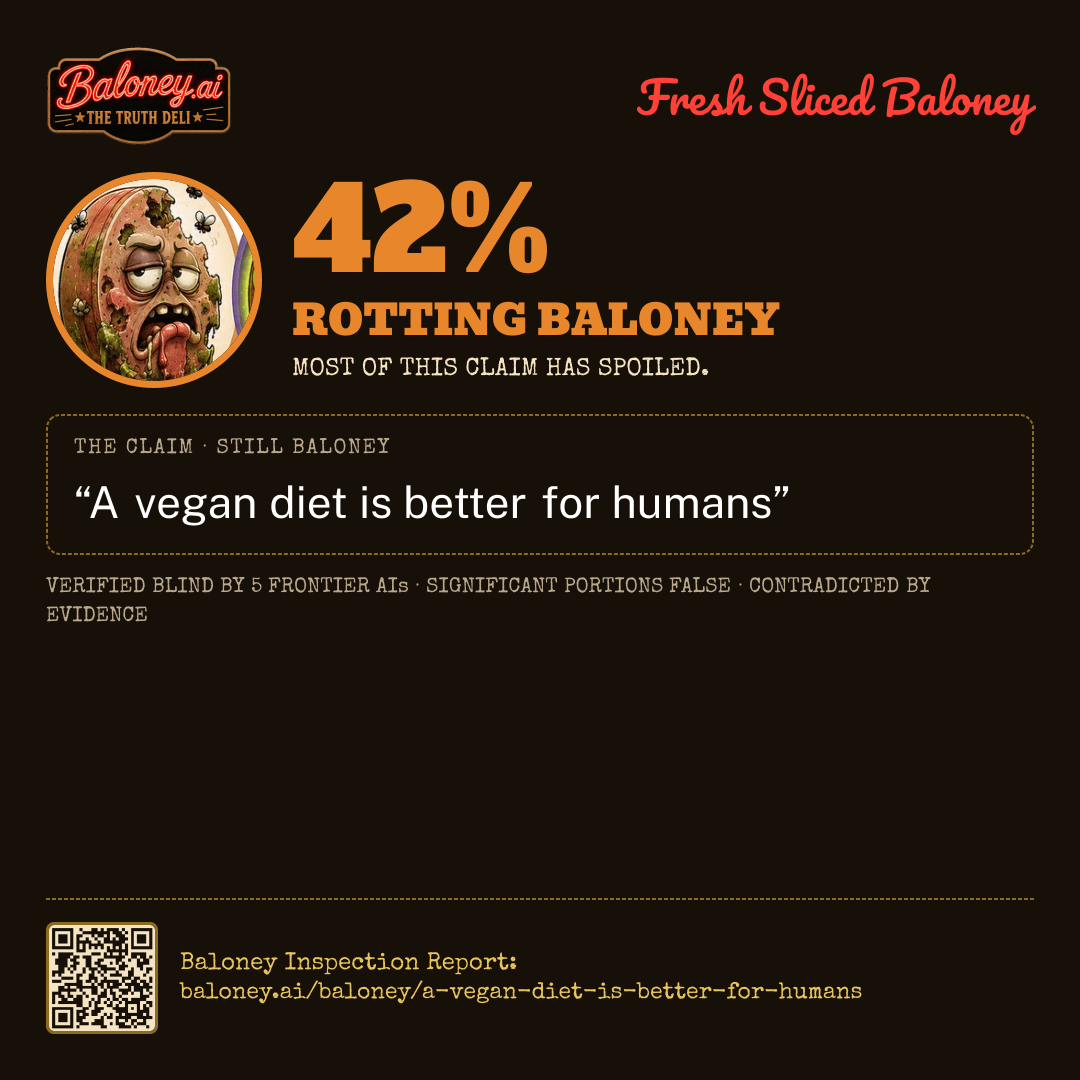
42% ROTTING BALONEY — THROW IT OUT! “A vegan diet is better for humans” Verified blind by 5 frontier AIs · Baloney Inspection Report: baloney.ai/baloney/a-vegan-diet-is-better-for-humans