


Anthropic · EQUAL WEIGHT · 39.7s
claude-opus-5
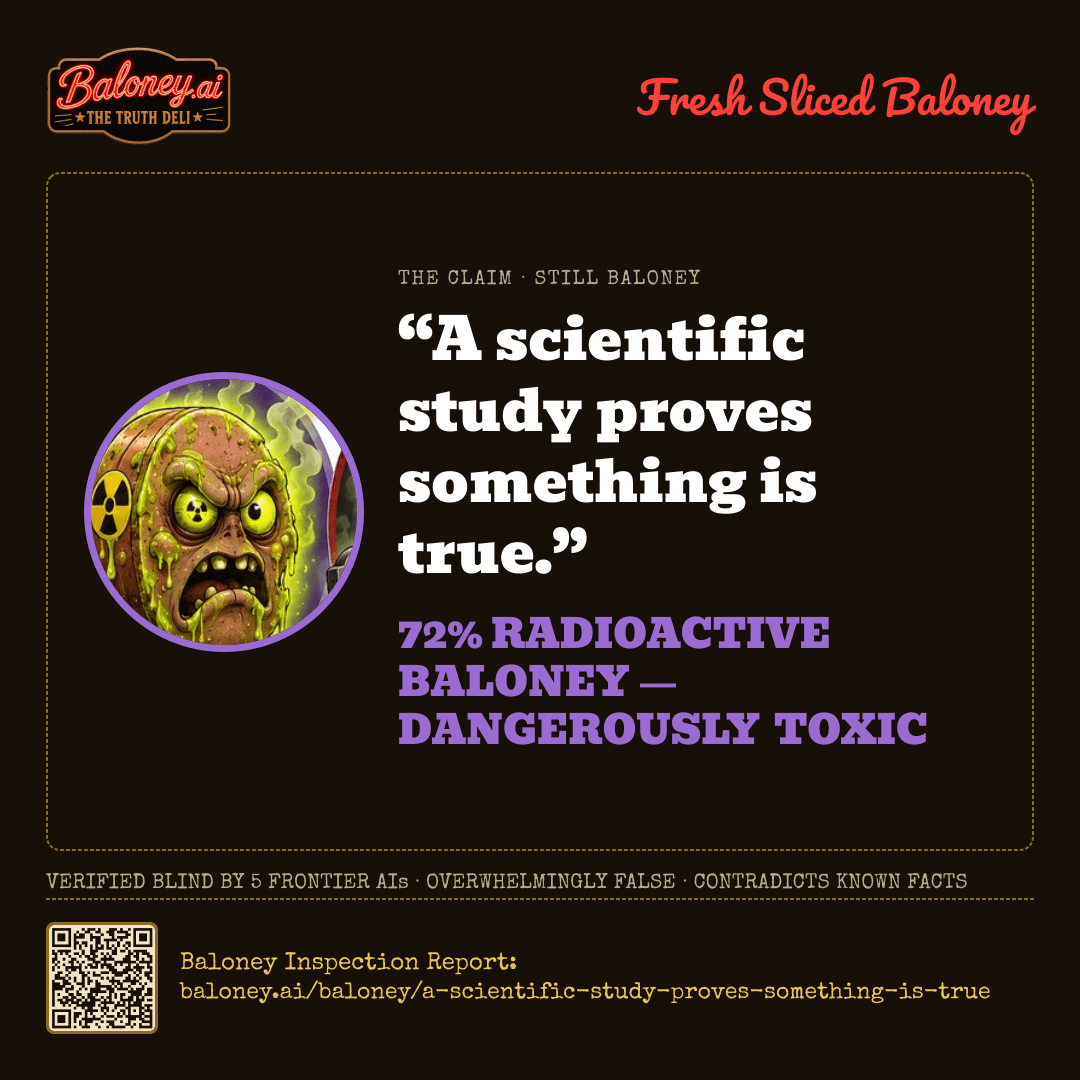
70%BALONEY
ROUND-1 BREAKDOWN
Evidence offered for the claim
- In everyday usage, 'proves' often means 'provides strong evidence for,' and well-designed studies (large, pre-registered, randomized controlled trials) can establish causal conclusions with very high confidence — e.g., the evidentiary base behind smoking–lung cancer causation or vaccine efficacy trials.
- Some scientific claims are effectively settled by observation: a single verified observation can definitively establish an existence claim (a new element, particle, or species) or definitively falsify a universal claim by counterexample, which is closer to genuine 'proof.'
- Regulatory and legal systems treat certain study results as dispositive: agencies such as the FDA and EMA approve drugs on the basis of 'substantial evidence' from adequate and well-controlled trials, operationally treating such findings as established fact.
- Formal deductive proof does exist inside science's mathematical and logical components (theorem proving, derivations), so the word 'proof' is not wholly alien to scientific practice.
- Empirical science is inductive and probabilistic: statistical inference quantifies uncertainty and can reject or fail to reject hypotheses, but cannot deductively establish truth. The American Statistical Association's 2016 statement explicitly warns that p-values do not measure the probability that a hypothesis is true and should not be treated as proof.
- Philosophy of science since Popper holds that theories can be corroborated or falsified but never conclusively verified; all empirical conclusions remain provisional and open to revision by new data.
- A *single* study is especially weak grounds for truth claims. The Open Science Collaboration (2015) replicated only about 36% of 100 published psychology findings, and Camerer et al. (2018) replicated roughly 13 of 21 high-profile social science experiments in Nature/Science, with effect sizes about half the originals.
- Ioannidis (2005) argued formally that, given small sample sizes, small effects, flexible analysis, and publication bias, most published research findings are likely false — directly undercutting 'a study proves it.'
- The U.S. National Academies' 2019 consensus report 'Reproducibility and Replicability in Science' emphasizes that confidence in a result comes from accumulated, replicated, and converging evidence, not a single publication.
- Numerous individual studies that were widely reported as 'proof' were later retracted or overturned (e.g., the 1998 Wakefield MMR–autism paper, retracted by The Lancet in 2010), demonstrating that publication is not proof.
- Observational studies are vulnerable to confounding, selection bias, and reverse causation, so they establish association rather than proven causation; even the Bradford Hill criteria are framed as guides to causal inference, not proof.
- The Royal Society's founding motto 'Nullius in verba' ('take nobody's word for it') reflects the institutional norm that claims are held open to independent testing rather than accepted as proven on authority.
90/100 — the lab’s own confidence in the score above, not a second reading of the claim.
SourcesOpen Science Collaboration, Science (AAAS)journal · 95 · Camerer et al., Nature Human Behaviourjournal · 93 · Ioannidis, PLOS Medicinejournal · 90 · Wasserstein & Lazar, The American Statistician (American Statistical Association)journal · 95 · National Academies of Sciences, Engineering, and Medicineedu · 96 · Stanford Encyclopedia of Philosophyedu · 92 · Understanding Science, University of California, Berkeleyedu · 85 · The Royal Societyother · 88 · U.S. Food and Drug Administrationgov · 90 · The Lancet (retraction of Wakefield et al. 1998)journal · 94