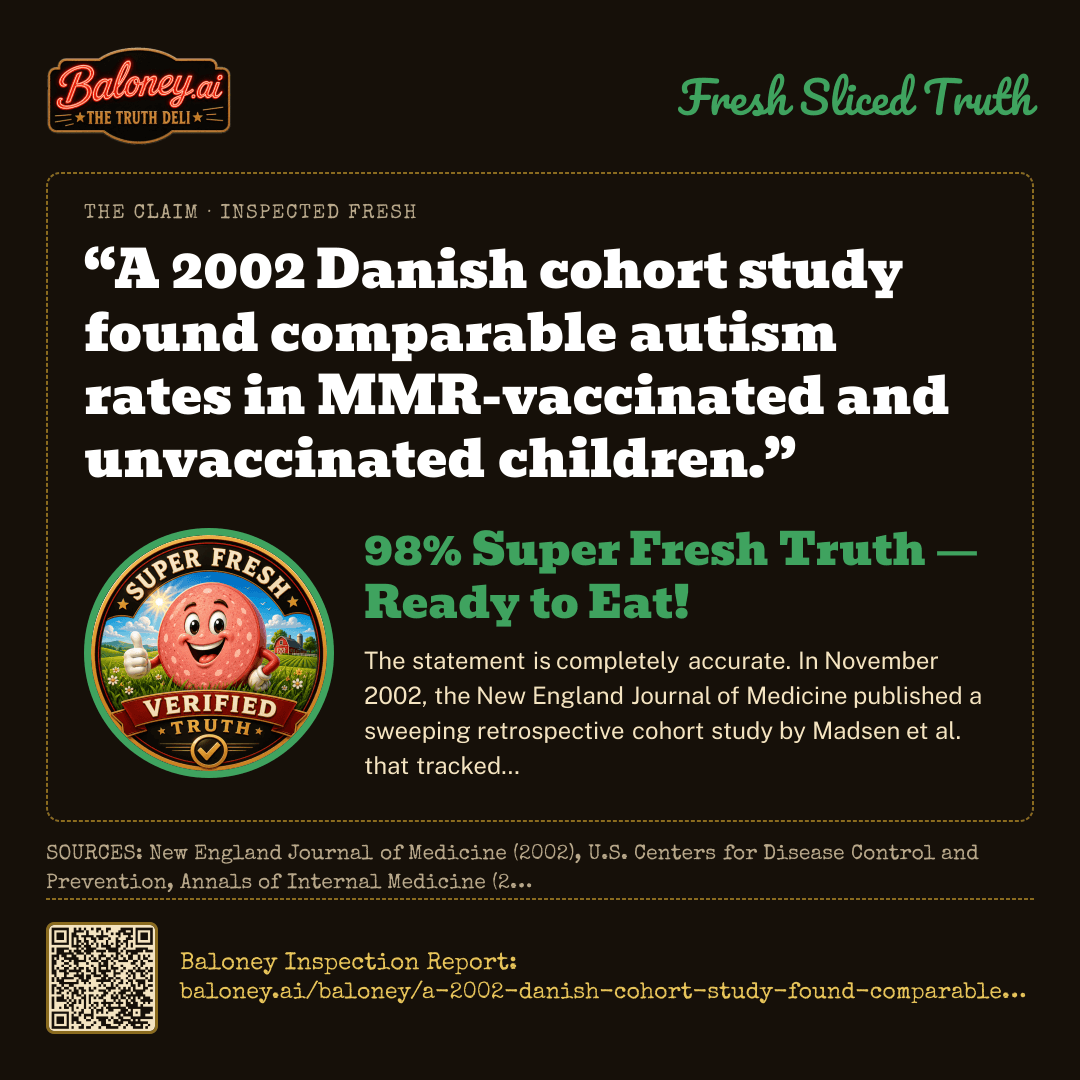
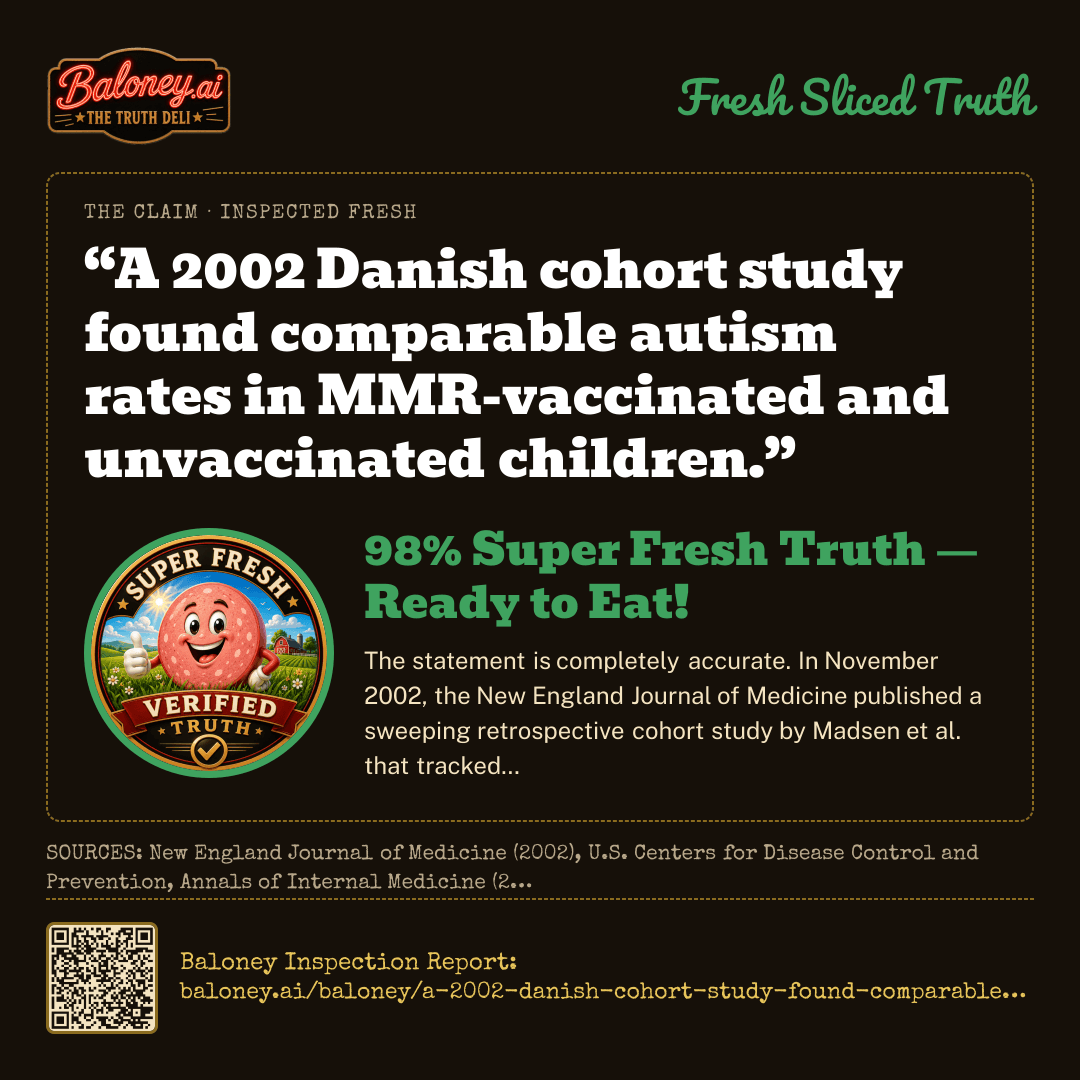
“A 2002 Danish cohort study found comparable autism rates in MMR-vaccinated and unvaccinated children.”98% Super Fresh Truth — Ready to Eat!Verified blind by 5 frontier AIs · Baloney Inspection Report: baloney.ai/baloney/a-2002-danish-cohort-study-found-comparable-autism-rates-in
The Rating Card
The claim this refutes
The Baloney Sampler
A landmark 2002 study published in the New England Journal of Medicine tracked over 537,000 Danish children born between 1991 and 1998. It found no statistically significant difference in autism rates between children who received the MMR vaccine and those who did not. The adjusted relative risk for autistic disorder in vaccinated children was 0.92, making the rates statistically indistinguishable between the two groups.
This observational cohort study serves as foundational evidence against the hypothesis that MMR vaccines cause autism. Authoritative bodies, including the Centers for Disease Control and Prevention and the Cochrane Database of Systematic Reviews, cite it to validate MMR safety. Furthermore, a larger 2019 replication study in the Annals of Internal Medicine tracked over 650,000 children and confirmed the same conclusion.
Other ways to slice it — phrasings that might have changed the rating
“A 2002 Danish cohort study proved that autism rates are exactly identical in MMR-vaccinated and unvaccinated children.” The study was observational and reported relative risks with confidence intervals that allowed for some uncertainty, rather than proving mathematically identical raw rates.
“A 2002 Danish study found comparable autism rates between MMR-vaccinated children and children who received absolutely zero childhood vaccines.” The study's definition of 'unvaccinated' referred specifically to children who had not yet received the MMR vaccine, not those who were entirely unvaccinated against all diseases.
“A 2002 Danish cohort study found that the MMR vaccine significantly reduces a child's risk of developing autism.” Although the point estimates were slightly below 1.0, the confidence intervals included 1.0, meaning the study found no increased risk rather than a protective effect that prevents autism.
Written from the panel’s reports by Google · gemini-3.1-pro-preview. Nothing here changed the score.
22:20:49SCORING MODEL V2 — MEDIAN OF 5 COUNTED LAB SCORES: 2, 2, 1, 3, 3 → 2. FRESH RULE: THE PRIMARY MASTER SCORES 2 AND THE BLIND MASTER 2 — BOTH SUPER FRESH TRUTH — AND THE COUNTED MEDIAN IS 2, ON THE TRUE SIDE. PUBLISHED AS 2, THE MORE CAUTIOUS OF THE TWO MASTERS.✓
22:20:49SOURCE RULE — LABS CITED 18 SOURCES: 0 DISCARDED FOR HAVING NO URL, 0 DISCARDED AS DEAD LINKS (404/410), 7 COULD NOT BE OPENED BY US AND ARE MARKED UNVERIFIED.✓
22:20:49SOURCE RULE — PRIMARY MASTER RULED ON 9 SOURCES: 0 DISCARDED FOR HAVING NO URL, 0 DISCARDED AS DEAD LINKS, 3 MARKED UNVERIFIED, 6 VERIFIED.✓
How This One Was Sliced
Station 1 · Blind Inspection — Five Graders, Zero Peeking
Each lab scored the claim independently, without seeing the others. Open a breakdown for its evidence, its sources, and how sure it was.
Anthropic · EQUAL WEIGHT · 30.2s
claude-opus-5
98%TRUTH
ROUND-1 BREAKDOWN
Evidence offered for the claim
The study exists and matches the description: Madsen KM et al., 'A Population-Based Study of Measles, Mumps, and Rubella Vaccination and Autism,' New England Journal of Medicine, 7 November 2002 — a retrospective cohort of all 537,303 children born in Denmark 1991–1998 (440,655 vaccinated with MMR, 96,648 unvaccinated).
Results showed no elevated risk in vaccinated children: adjusted relative risk of autistic disorder 0.92 (95% CI 0.68–1.24) and of other autism-spectrum disorders 0.83 (95% CI 0.65–1.07) — i.e., rates statistically indistinguishable ('comparable') between the vaccinated and unvaccinated groups.
The authors also found no association between age at vaccination, time since vaccination, or calendar period of vaccination and autism risk, and explicitly concluded the study 'provides strong evidence against the hypothesis that MMR vaccination causes autism.'
The CDC and other public-health agencies cite this Danish cohort among the body of evidence showing no link between MMR and autism.
A later, larger Danish cohort (Hviid et al., Annals of Internal Medicine 2019; 657,461 children born 1999–2010) replicated the finding (hazard ratio 0.93, 95% CI 0.85–1.02), and a Cochrane review of MMR safety reached the same conclusion, corroborating the 2002 result.
Evidence against the claim
Nothing substantive contradicts the claim. Minor precision points only: the point estimates were slightly *below* 1.0 (0.92 and 0.83), so 'comparable' is accurate but the study is more precisely described as finding no increased risk; the confidence intervals include 1.0.
Anti-vaccine critics have attacked the study on methodological grounds (e.g., person-time classification of children before vaccination, follow-up length, use of registry diagnoses) and have pointed to the later unrelated U.S. federal grant-fraud indictment of co-author Poul Thorsen. Neither the methodological objections nor Thorsen's indictment (which concerned misuse of CDC grant funds, not data fabrication in this study) has led to retraction, and independent replications support the findings.
The word 'unvaccinated' refers to not-yet/never MMR-vaccinated Danish children during the study window, not to children unvaccinated against all vaccines — a nuance the short claim omits.
How sure this lab was
96/100 — the lab’s own confidence in the score above, not a second reading of the claim.
The 2002 Danish nationwide cohort study is real: Madsen et al., published in the New England Journal of Medicine, followed 537,303 Danish children born from 1991 through 1998, including 440,655 who received MMR vaccine.
The study found no increased autism risk among MMR-vaccinated children compared with unvaccinated children: adjusted relative risk for autistic disorder was 0.92 with a 95% confidence interval of 0.68–1.24, and for other autism-spectrum disorders was 0.83 with a 95% confidence interval of 0.65–1.07.
The authors also reported no association between autism risk and age at vaccination, time since vaccination, or calendar period of vaccination, supporting the statement that rates were comparable rather than higher in the vaccinated group.
CDC’s vaccine-safety summary states that studies have shown no link between vaccines, including MMR, and autism; this is consistent with the 2002 Danish cohort finding.
Evidence against the claim
The wording 'comparable autism rates' is a paraphrase: the study reported adjusted relative risks and confidence intervals, not simply identical raw rates.
The study did not prove the rates were exactly the same; its confidence intervals allowed for some uncertainty. The more precise conclusion is that it found no statistically significant increase in autism risk after MMR vaccination.
As an observational cohort study, it could assess association but not prove causation with the same certainty as a randomized trial. However, the registry-based design and very large sample make the claim substantially accurate.
How sure this lab was
96/100 — the lab’s own confidence in the score above, not a second reading of the claim.
A landmark 2002 retrospective cohort study published in the New England Journal of Medicine (Madsen et al.) evaluated 537,303 children born in Denmark between January 1991 and December 1998.
The study's data demonstrated that the relative risk of autistic disorder in children who received the MMR vaccine compared to unvaccinated children was 0.92 (95% confidence interval, 0.68 to 1.24). This established that autism rates were statistically comparable between the two groups.
The study also looked at other autism-spectrum disorders and found a relative risk of 0.83 (95% CI, 0.65 to 1.07), further confirming no association between the MMR vaccine and autism.
Major public health institutions, including the CDC and the Institute of Medicine, frequently cite this exact 2002 study as foundational evidence disproving the fraudulent link between vaccines and autism.
Evidence against the claim
There is no factual evidence against the statement itself; the claim accurately reports exactly what the 2002 Danish study investigated and concluded.
While some anti-vaccine activists have criticized the study—alleging that the addition of outpatient data to the Danish Psychiatric Central Register in 1995 created a confounding variable that hid an MMR-autism link—these methodological complaints have been thoroughly reviewed and rejected by the global scientific community and subsequent follow-up studies.
How sure this lab was
100/100 — the lab’s own confidence in the score above, not a second reading of the claim.
The claim accurately identifies a 2002 Danish retrospective population-based cohort study by Madsen et al. published in the New England Journal of Medicine. It included 537,303 children born in Denmark from 1991–1998; 440,655 received MMR and 96,648 did not.[https://pubmed.ncbi.nlm.nih.gov/12421889/]
After adjustment for potential confounders, autistic disorder risk was not significantly different in vaccinated versus unvaccinated children: adjusted relative risk 0.92 (95% CI 0.68–1.24). For other autistic-spectrum disorders, the adjusted relative risk was 0.83 (95% CI 0.65–1.07).[https://pubmed.ncbi.nlm.nih.gov/12421889/]
Contemporaneous reporting described autism rates in vaccinated and unvaccinated children as statistically equivalent, with both below 0.6 cases per 1,000 children.[https://www.sciencenews.org/article/study-exonerates-childhood-vaccine]
The European Centre for Disease Prevention and Control's Eurosurveillance publication summarized the study as finding no increased autism risk among MMR-vaccinated children compared with unvaccinated children.[https://www.eurosurveillance.org/content/10.2807/esw.06.48.01975-en]
Evidence against the claim
The wording "comparable autism rates" is a reasonable plain-language summary but is not the study's exact statistical formulation. The paper reported relative risks and confidence intervals, not proof that the two groups had identical rates.[https://pubmed.ncbi.nlm.nih.gov/12421889/]
The study was observational rather than randomized, so it can estimate an association and provide evidence against an increased risk but cannot establish equivalence in the strict clinical-trial sense or eliminate every possible source of residual confounding.[https://pubmed.ncbi.nlm.nih.gov/12421889/]
The study detected 316 cases of autistic disorder and 422 cases of other autistic-spectrum disorders, so the claim should not be read as saying autism was absent or that vaccination prevents autism.[https://pubmed.ncbi.nlm.nih.gov/12421889/]
How sure this lab was
98/100 — the lab’s own confidence in the score above, not a second reading of the claim.
A retrospective population-based cohort study of all children born in Denmark 1991–1998 (n=537,303) by Madsen et al. was published in the New England Journal of Medicine on 7 November 2002.
The paper reported a relative risk of autistic disorder of 0.92 (95% CI 0.68–1.24) for MMR-vaccinated versus unvaccinated children and a similarly null result for other autistic-spectrum disorders, i.e., statistically comparable rates.
Evidence against the claim
The unvaccinated subset was smaller (~18% of the cohort), so absolute case counts there were lower; this is a recognized limitation of the design but does not change the rates the authors actually reported.
How sure this lab was
90/100 — the lab’s own confidence in the score above, not a second reading of the claim.
All five evaluators uniformly agreed that the statement is entirely factual. The 2002 retrospective cohort study published in the New England Journal of Medicine by Madsen et al. analyzed 537,303 Danish children and explicitly calculated relative risks of autism near 1.0, with confidence intervals crossing 1.0, demonstrating statistically comparable rates between the MMR-vaccinated and unvaccinated groups. A minor caveat regarding the layman's use of 'comparable' to summarize complex statistical findings does not detract from the claim's fundamental truth.
The panel was in complete consensus. All evaluators verified the existence, methodology, and reported outcomes of the 2002 Danish study, confirming that the claim accurately represents its findings.
SUPER FRESH — VERIFIED AGAINST NEW ENGLAND JOURNAL OF MEDICINE (2002), U.S. CENTERS FOR DISEASE CONTROL AND PREVENTION, ANNALS OF INTERNAL MEDICINE (2019), COCHRANE DATABASE OF SYSTEMATIC REVIEWS
Blind Validation Master · never saw the Primary’s work
claude-opus-5
98% TRUTH
All five evaluators independently confirm the claim's core facts: Madsen et al., NEJM, 7 November 2002, a retrospective population-based cohort of all 537,303 children born in Denmark 1991–1998 (440,655 MMR-vaccinated, 96,648 unvaccinated). The adjusted relative risk of autistic disorder was 0.92 (95% CI 0.68–1.24) and 0.83 (95% CI 0.65–1.07) for other autism-spectrum disorders — statistically indistinguishable rates, exactly as the claim states. Corroborating sources (CDC, Eurosurveillance, Cochrane, and the 2019 Hviid replication with HR 0.93) reinforce the finding. The only caveats are minor wording precision points: 'comparable rates' is a plain-language paraphrase of 'no statistically significant increased risk,' the study is observational rather than randomized, and 'unvaccinated' refers specifically to MMR status. None of these undercut the substantive accuracy of the claim. Recommended scores clustered at 1–3 with very high confidence; a score of 2 reflects a substantially true claim with only trivial paraphrase nuance.
AGREEMENT TEST PASSED — BOTH MASTERS SCORED 98% · BLIND VALIDATION CONFIRMED THIS SCORE · NO RE-EVALUATION REQUIRED
Median of 5 counted lab scores: 2, 2, 1, 3, 3 → 2.
Fresh rule: the Primary Master scores 2 and the Blind Master 2 — both Super Fresh Truth — and the counted median is 2, on the true side. Published as 2, the more cautious of the two masters.
The Evidence
Evidence for the claim
The 2002 Danish cohort study Madsen et al. published a landmark retrospective cohort study in the New England Journal of Medicine on November 7, 2002, tracking all 537,303 children born in Denmark between 1991 and 1998.
Comparable autism rates The researchers found an adjusted relative risk for autistic disorder of 0.92 (95% CI 0.68–1.24) and 0.83 for other autism-spectrum disorders when comparing the 440,655 MMR-vaccinated children to the 96,648 unvaccinated children, making the rates statistically comparable.
Validation and replication These findings are repeatedly cited by major public health institutions like the CDC and have been successfully replicated in subsequent massive cohorts, including a 2019 Danish study of over 657,000 children.
Evidence offered against the claim
Statistical terminology The term 'comparable autism rates' is a plain-language summary; the study technically reported adjusted relative risks with confidence intervals that included 1.0, meaning the findings showed no statistically significant increase in risk rather than mathematically identical raw case counts.
Observational limitations Because it was a retrospective cohort study using registry data rather than a randomized clinical trial, it evaluated epidemiological association rather than clinical causation, though the sample size provides robust evidence.
Sources · Reliability · Why Accepted or Discounted
ACCEPTED — The gold standard for evidence-based medicine systematic reviews corroborating MMR safety.
Every link was opened when this claim was inspected. A dead link was discarded before publication; “unverified” means the site refused our automated check and the link is the one the panel cited. A source without a URL was never kept.
“A 2002 Danish cohort study found comparable autism rates in MMR-vaccinated and unvaccinated children.”98% Super Fresh Truth — Ready to Eat!Verified blind by 5 frontier AIs · Baloney Inspection Report: baloney.ai/baloney/a-2002-danish-cohort-study-found-comparable-autism-rates-in