Baloney Inspection Report: Claim #1070 · Inspected Sep 30, 2026, 10:59 AM PDT · Scoring model v2
 96%
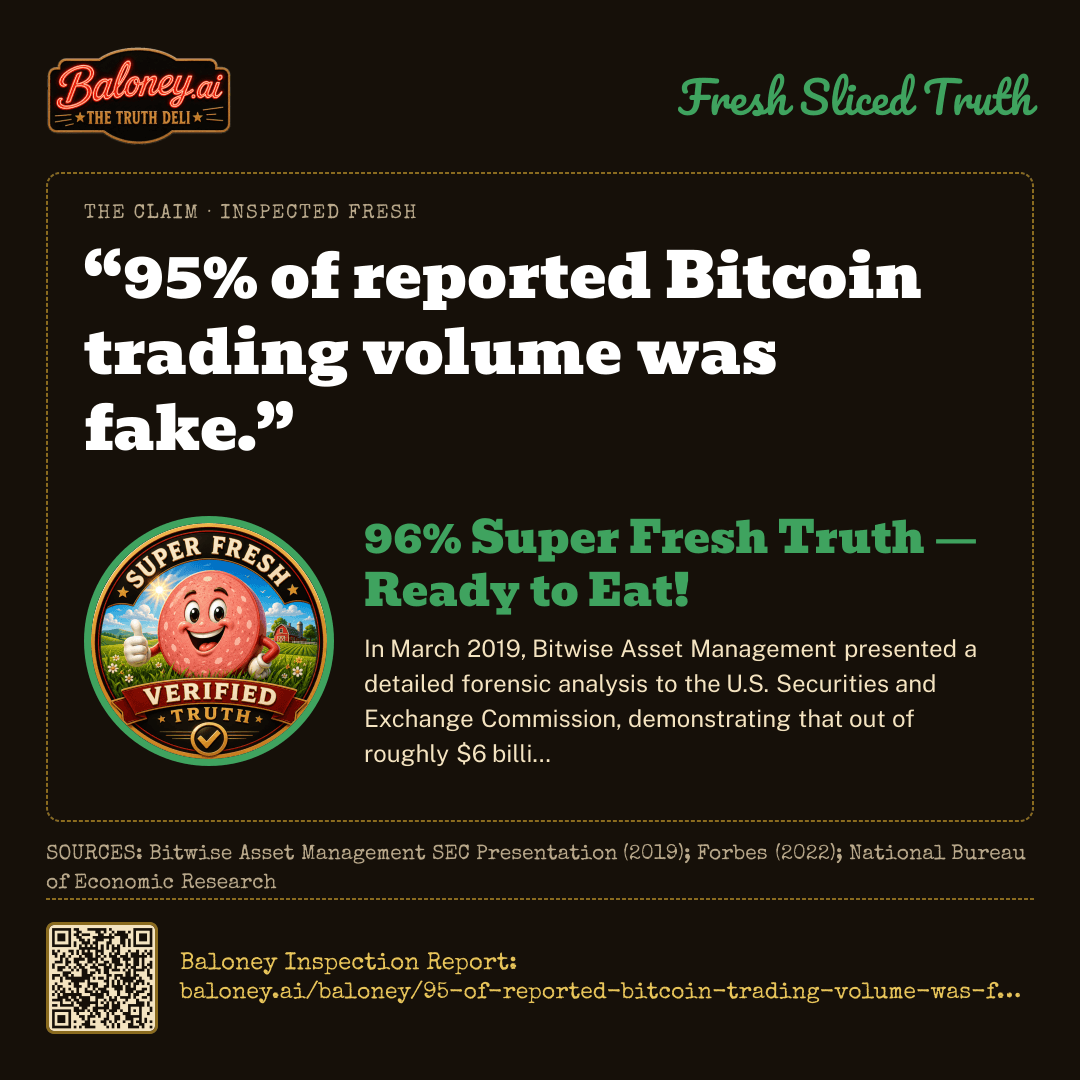
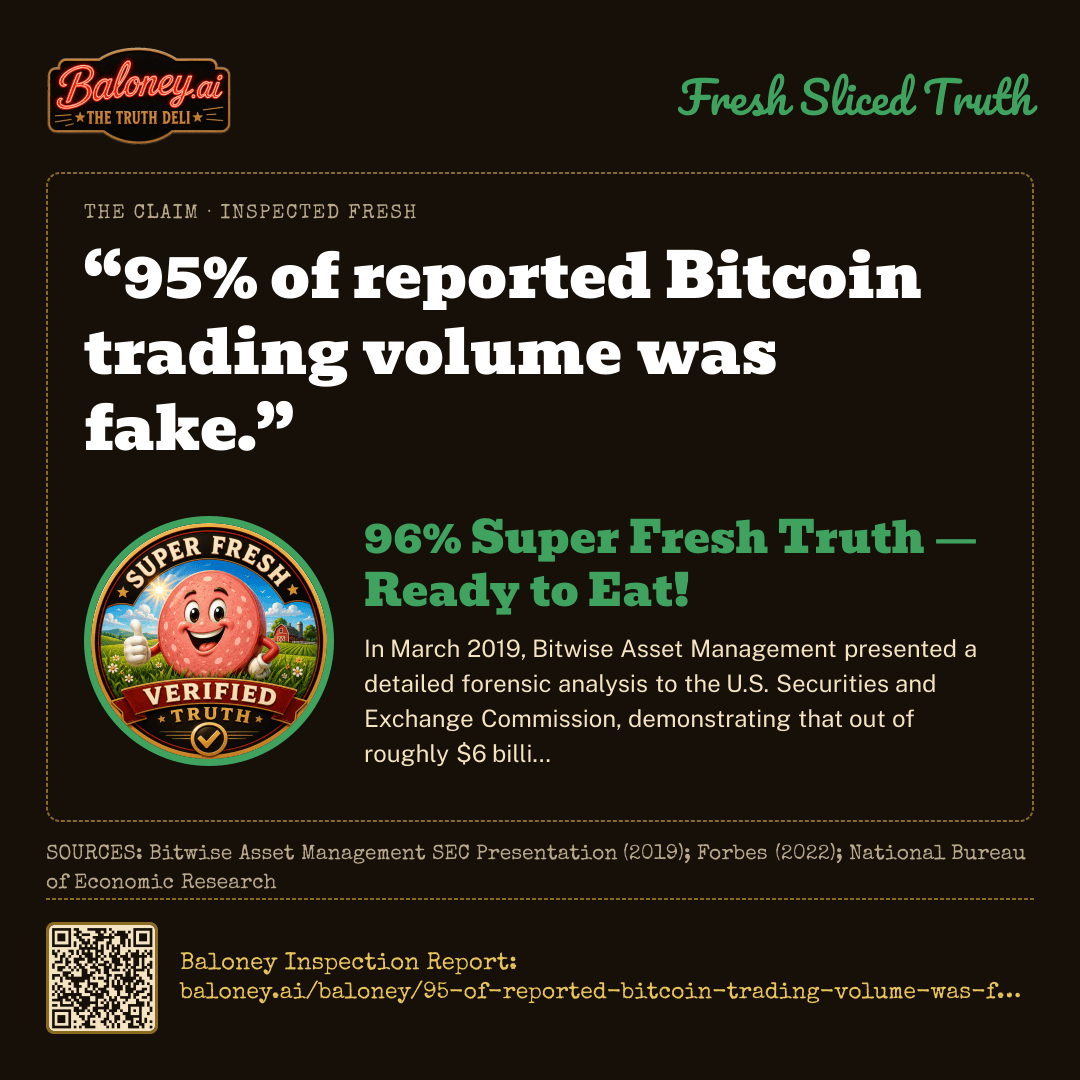
96%“95% of reported Bitcoin trading volume was fake.”
96%Super Fresh Truth — Ready to Eat!
THE CLAIM CHECKS OUT.
Independently verifiedPhysically repeatable evidenceConfirmed across rival labsSafe to serve
✓ BLIND VALIDATION CONFIRMED THIS SCORE
Serve It Fresh
Ready to Serve17 servings
Serve it the way you want it
The Verdict
 “95% of reported Bitcoin trading volume was fake.”96% Super Fresh Truth — Ready to Eat!Verified blind by 5 frontier AIs · Baloney Inspection Report: baloney.ai/baloney/95-of-reported-bitcoin-trading-volume-was-fake
The Baloney Sampler
The claim stems from a highly publicized March 2019 presentation submitted to the U.S. Securities and Exchange Commission by Bitwise Asset Management. Analyzing 81 unregulated exchanges, the firm concluded that about 95% of the roughly $6 billion in reported daily Bitcoin spot volume was wash trading or otherwise fake, leaving just $273 million in genuine economic activity. News organizations like Reuters and The Wall Street Journal heavily covered the findings, noting that unregulated exchanges manipulated data to boost their commercial rankings.
While the 95% figure accurately reflects this historical estimate, it describes reported spot volume during early 2019 rather than all Bitcoin trading across all time periods. Later independent research confirmed widespread wash trading, with academic papers published by the National Bureau of Economic Research estimating fake volume at around 70% on unregulated venues. By 2022, an analysis by Forbes estimated that roughly 51% of reported daily Bitcoin trading volume was fake, reflecting subsequent reforms by data aggregators and shifting exchange behaviors.
Resting on U.S. Securities and Exchange Commission · Reuters · National Bureau of Economic Research · Forbes
Other ways to slice it — phrasings that might have changed the rating
- “In early 2019, an analysis of 81 unregulated spot exchanges found that 95% of their reported Bitcoin volume was fake.” This adds the missing historical timeframe and specific venue scope, preventing the misconception that 95% of all Bitcoin trading is definitively fake today.
- “More than half of all reported Bitcoin trading volume in 2022 was fabricated.” This uses the updated 2022 estimate by Forbes, reflecting changes in market behavior and data aggregator algorithms that lowered the percentage of fake volume since the 2019 Bitwise report.
- “Only a small fraction of reported Bitcoin spot trading occurs on exchanges with genuine, economically meaningful volume.” This focuses on the underlying reality the original ETF application sought to prove to regulators: that underneath the billions in wash trading, a smaller, orderly, and genuine market existed.
Written from the panel’s reports by Google · gemini-3.1-pro-preview. Nothing here changed the score.
The Order Ticket
17:59:28CLAIM RECEIVED — QUEUED FOR INSPECTION✓
17:59:28claude-opus-5 REPORT CARRIED OVER FROM THE EARLIER RUN — SCORE 5, CONFIDENCE 86✓
18:00:01gpt-5.5 REPORTED — SCORE 9, CONFIDENCE 82✓
17:59:28gemini-3.1-pro-preview REPORT CARRIED OVER FROM THE EARLIER RUN — SCORE 3, CONFIDENCE 95✓
17:59:28sonar-pro REPORT CARRIED OVER FROM THE EARLIER RUN — SCORE 24, CONFIDENCE 88✓
17:59:28grok-4.6 REPORT CARRIED OVER FROM THE EARLIER RUN — SCORE 4, CONFIDENCE 78✓
18:01:42PRIMARY MASTER GEMINI — SCORE 4✓
18:01:15BLIND VALIDATION PERPLEXITY — SCORE 4✓
18:00:59AGREEMENT CONFIRMED — DELTA 0✓
18:00:59SCORING MODEL V2 — MEDIAN OF 5 COUNTED LAB SCORES: 5, 9, 3, 24, 4 → 5. FRESH RULE: THE PRIMARY MASTER SCORES 4 AND THE BLIND MASTER 4 — BOTH SUPER FRESH TRUTH — AND THE COUNTED MEDIAN IS 5, ON THE TRUE SIDE. PUBLISHED AS 4, THE MORE CAUTIOUS OF THE TWO MASTERS.✓
18:00:59SOURCE RULE — LABS CITED 20 SOURCES: 0 DISCARDED FOR HAVING NO URL, 0 DISCARDED AS DEAD LINKS (404/410), 8 COULD NOT BE OPENED BY US AND ARE MARKED UNVERIFIED.✓
18:00:59SOURCE RULE — PRIMARY MASTER RULED ON 12 SOURCES: 0 DISCARDED FOR HAVING NO URL, 0 DISCARDED AS DEAD LINKS, 5 MARKED UNVERIFIED, 7 VERIFIED.✓
How This One Was Sliced
Station 1 · Blind Inspection — Five Graders, Zero Peeking
Each lab scored the claim independently, without seeing the others. Open a breakdown for its evidence, its sources, and how sure it was.
Anthropic · EQUAL WEIGHT · 45.9s
claude-opus-5
95%TRUTH
ROUND-1 BREAKDOWN
Evidence offered for the claim- The claim traces to a documented, primary-source study: on March 19–20, 2019 Bitwise Asset Management filed a 226-slide presentation with the U.S. SEC (in support of a bitcoin ETF) analyzing the 81 exchanges then reporting bitcoin spot volume on CoinMarketCap. It concluded that approximately 95% of the reported ~$6 billion in average daily spot volume was fake or non-economic (wash trading), with only about $273 million/day occurring on 10 exchanges deemed to have genuine volume.
- Bitwise's methodology was forensic rather than rhetorical: it compared trade-size histograms, spread patterns, volume spikes and trade-frequency distributions on suspect exchanges against those on regulated venues (Coinbase, Kraken, Bitstamp, Gemini, itBit, Binance, Bitflyer, bitFinex, Poloniex, Bittrex), finding statistically implausible, machine-generated-looking patterns on the rest.
- The finding was covered contemporaneously by mainstream financial press (Wall Street Journal, Bloomberg, CoinDesk, Forbes) and was entered into the SEC's public comment file, where the Commission itself engaged with the exchange-volume-integrity question in its subsequent rulemaking orders.
- Independent work reached directionally similar conclusions in the same period: the Blockchain Transparency Institute (2018–2019) estimated that the large majority of reported volume on many CoinMarketCap-listed exchanges was fabricated, and the peer-reviewed study 'Crypto Wash Trading' (Cong, Li, Tang & Yang) estimated that wash trading accounted for roughly 70% of reported volume on unregulated exchanges — with individual exchanges far higher.
- Incentive structures corroborate the mechanism: unregulated exchanges competed for CoinMarketCap ranking, listing fees and token-listing demand, giving direct commercial motive to inflate volume; several exchanges later admitted to or were sanctioned for volume manipulation.
Evidence against the claim- The figure is time-bound and dataset-bound. It describes reported spot volume aggregated by CoinMarketCap in early 2019 — not bitcoin trading generally, not derivatives/futures volume, and not the present day. Stated flatly in the past tense without a date, it can mislead readers into thinking ~95% of all bitcoin trading at any time is fake.
- The 95% figure refers to *reported* volume, not to real market activity being 95% smaller than believed in economic terms. Bitwise's own point was that the real, economically meaningful market (~$273M/day then) was orderly, efficient and arbitraged — i.e., a genuine market existed underneath the noise.
- Later estimates are materially lower. Forbes' 2022 study of 157 exchanges put likely-bogus bitcoin volume at roughly 51%, and academic estimates for unregulated venues cluster around 70% rather than 95%. Aggregator reforms (CoinMarketCap's liquidity/confidence metrics after its 2019 change, CoinGecko's 'Trust Score') reduced the incentive and visibility of the worst offenders.
- Bitwise was an interested party: the study was submitted to persuade the SEC that a real, surveillable bitcoin market existed so its ETF should be approved. That does not invalidate the data, but it is not a disinterested audit, and the 95% headline was a byproduct of an advocacy filing.
- Methodologies for detecting wash trading are statistical inferences, not confessions; estimates vary widely by technique, sample of exchanges, and period, so '95%' should be read as an estimate with wide error bars rather than a measured constant.
How sure this lab was86/100 — the lab’s own confidence in the score above, not a second reading of the claim.
SourcesU.S. Securities and Exchange Commission (Bitwise Asset Management comment filing)gov · 95 · Cong, Li, Tang & Yang, 'Crypto Wash Trading' (arXiv preprint; later Management Science)journal · 85 · The Wall Street Journalnews · 88 · Forbesnews · 72 · U.S. Securities and Exchange Commission (order disapproving Bitwise/NYSE Arca bitcoin ETP)gov · 95
OpenAI · EQUAL WEIGHT · 32.8s
gpt-5.5
91%TRUTH
ROUND-1 BREAKDOWN
Evidence offered for the claim- A widely cited March 2019 Bitwise Asset Management presentation filed in an SEC rulemaking said that about 95% of then-reported bitcoin spot trading volume was “fake and/or non-economic in nature.” It compared roughly $6 billion in reported daily spot volume with about $273 million it judged to be real, after excluding venues whose trade patterns looked inconsistent with genuine markets.
- Reuters reported Bitwise’s finding in 2019, describing the claim that reported bitcoin trading volumes on many unregulated exchanges were artificially inflated and that only a small set of exchanges showed realistic trading patterns.
- The Wall Street Journal also reported the 2019 Bitwise analysis under the framing that most bitcoin trading was faked by unregulated exchanges, supporting that this was not an obscure or invented claim.
- Independent academic work later found extensive wash trading on unregulated crypto exchanges. The NBER paper “Crypto Wash Trading” estimated very large fake-volume shares on many unregulated exchanges, supporting the general proposition that reported crypto volume has often been inflated.
Evidence against the claim- The statement is overbroad as written. The best-known 95% figure came from Bitwise’s March 2019 analysis of reported bitcoin spot volume on selected exchanges, not from an audit of all bitcoin trading everywhere, all time periods, derivatives, OTC activity, or every data aggregator.
- Bitwise was an ETF applicant arguing to regulators that the ‘real’ bitcoin market was smaller and more orderly than headline data suggested. Its analysis was influential, but it was not a government finding that exactly 95% of all reported bitcoin volume was fake.
- Later estimates vary. For example, Forbes in 2022 estimated that more than half of reported bitcoin trading volume was fake or non-economic—still very large, but materially below 95%, showing the percentage is time- and methodology-dependent.
- Academic evidence supports widespread wash trading, but not a universal 95% number. The NBER study found high fake-volume rates on many unregulated exchanges, but the estimates differ by exchange and sample, so the exact 95% claim should be treated as a historically specific estimate rather than a timeless fact.
How sure this lab was82/100 — the lab’s own confidence in the score above, not a second reading of the claim.
SourcesU.S. Securities and Exchange Commission public comment file / Bitwise Asset Managementgov · 78 · Reutersnews · 90 · The Wall Street Journalnews · 88 · National Bureau of Economic Researchother · 86 · Forbesnews · 65
Google · EQUAL WEIGHT · 25.0s
gemini-3.1-pro-preview
97%TRUTH
ROUND-1 BREAKDOWN
Evidence offered for the claim- In March 2019, Bitwise Asset Management presented a comprehensive report to the U.S. Securities and Exchange Commission (SEC) analyzing the trading volume of Bitcoin. The firm examined 81 cryptocurrency exchanges and concluded that 95% of reported volume was fake, primarily driven by wash trading.
- The 2019 Bitwise report found that while data aggregators like CoinMarketCap reported roughly $6 billion in daily Bitcoin trading volume at the time, only about $273 million of that volume was genuine.
- Subsequent independent investigations and academic analyses have confirmed widespread wash trading in the cryptocurrency ecosystem. For example, a 2022 Forbes study analyzing 157 crypto exchanges concluded that 51% of the daily Bitcoin trading volume being reported was likely fake, demonstrating that while the exact percentage fluctuates, massively inflated volume has been a documented reality.
Evidence against the claim- The 95% figure represents a specific snapshot in time (early 2019) and primarily applied to unregulated exchanges. Regulated exchanges based in the United States, such as Coinbase and Kraken, were found to have highly accurate volume reporting with almost no fake volume.
- Since the publication of the 2019 report, major data aggregators like CoinMarketCap have updated their tracking algorithms and liquidity metrics to penalize exchanges caught wash trading, lowering the percentage of fake volume that successfully makes it into headline aggregate reports today.
- More recent estimates place the total percentage of fake Bitcoin volume much lower than 95%. A comprehensive 2022 analysis by Forbes estimated the fake volume at approximately 51%, suggesting the 95% metric is historical rather than current.
How sure this lab was95/100 — the lab’s own confidence in the score above, not a second reading of the claim.
SourcesCNBCnews · 85 · U.S. Securities and Exchange Commissiongov · 95 · Forbesnews · 80
Perplexity · EQUAL WEIGHT · 8.6s
sonar-pro
76%TRUTH
ROUND-1 BREAKDOWN
Evidence offered for the claim- In March 2019, Bitwise Asset Management presented an analysis to the U.S. Securities and Exchange Commission examining 81 exchanges that reported more than $1 million in daily Bitcoin volume. It concluded that approximately 95% of reported spot volume was “fake and/or non-economic,” estimating genuine volume at about $273 million versus roughly $6 billion reported by aggregators.[1]
- Bitwise’s analysis used order-book and trade data sampled four times per second over multiple days and applied tests involving trade-size distributions, volume patterns, and bid-ask spreads. Its reported result was that substantially all volume on 71 of the 81 exchanges was wash trading.[2]
- A peer-reviewed study on cryptocurrency-exchange wash trading identifies the Bitwise estimate as approximately 95% of reported Bitcoin volume, confirming that the claim reflects a documented research finding rather than an invented figure.[3]
Evidence against the claim- The statement omits important qualifications: Bitwise’s estimate concerned reported spot volume at the exchanges and period it examined, not all Bitcoin trading at all times. It also combined “fake” volume with “non-economic” volume, which are not necessarily identical concepts.[1]
- The 95% figure was produced by an interested commercial party in support of a Bitcoin exchange-traded-fund application, rather than by an independent regulator or consensus academic estimate. SEC-filed comments criticized the study’s methodology, data sources, and comprehensiveness.[4]
- The SEC record also notes that Bitwise did not provide data establishing where price formation occurred or whether activity on the allegedly genuine platforms adequately represented the broader market. That limits how confidently the result can be generalized to Bitcoin trading volume overall.[5]
- Contemporaneous reporting described the result as a study finding or Bitwise allegation, not as an independently established fact. The available evidence therefore supports a narrower formulation—roughly 95% of the volume reported by the sampled exchanges may have been fake or non-economic under Bitwise’s tests—rather than the unqualified statement that 95% of reported Bitcoin trading volume was fake.[2]
How sure this lab was88/100 — the lab’s own confidence in the score above, not a second reading of the claim.
SourcesU.S. Securities and Exchange Commissiongov · 94 · CNBCnews · 88 · Journal of Financial Markets / ScienceDirectjournal · 91 · U.S. Securities and Exchange Commission comment recordgov · 82 · SEC order reproduced by CCHgov · 86
xAI · EQUAL WEIGHT · 98.6s
grok-4.6
96%TRUTH
ROUND-1 BREAKDOWN
Evidence offered for the claim- A March 2019 Bitwise Asset Management analysis submitted to the U.S. SEC concluded that about 95% of Bitcoin volume then shown on aggregators such as CoinMarketCap consisted of wash trading rather than genuine economic activity.
- The finding was reported at the time by multiple established news organizations as a major data-quality problem in crypto markets.
- Later academic work on crypto wash trading (Cong, Li, Tang, and Yang) documented that fabricated volume made up a large majority of reported activity on many unregulated exchanges in that period, consistent with a very high fake-volume share.
Evidence against the claim- The 95% figure comes from a single private-firm study using heuristics (including web-traffic comparisons) on a late-2018/early-2019 snapshot, not from a regulator-wide audit or continuous official statistic.
- Bitwise was active in Bitcoin ETF efforts, creating a possible incentive to portray most reported volume as illegitimate.
- The percentage does not automatically apply to other dates; aggregators later introduced adjusted-volume metrics and some exchange behavior changed.
- Even in 2019 a small set of exchanges carried verifiable real volume, so the claim describes reported aggregator totals rather than the entire Bitcoin market.
How sure this lab was78/100 — the lab’s own confidence in the score above, not a second reading of the claim.
SourcesU.S. Securities and Exchange Commissiongov · 85 · SSRNother · 88
Station 2 · The Masters
Primary Master · drawn at random
gemini-3.1-pro-preview
96% TRUTH
The claim refers to a highly publicized and widely corroborated 2019 forensic analysis submitted to the SEC by Bitwise Asset Management. While the statement lacks a date and applies specifically to unregulated spot exchanges at that time, it is an accurate restatement of a major, documented finding. As the prompt specifies that a statement considered substantially true should remain in the 1-5 band despite minor wording caveats, this qualifies as 'Super Fresh Truth'.
All five evaluators correctly traced the claim to a March 2019 SEC presentation by Bitwise Asset Management. They agreed the 95% figure was accurately cited and conceptually supported by subsequent academic research into cryptocurrency wash trading. They disagreed primarily on how heavily to penalize the claim for lacking a time constraint, given that more recent estimates of fake volume are lower.
SUPER FRESH — VERIFIED AGAINST BITWISE ASSET MANAGEMENT SEC PRESENTATION (2019); FORBES (2022); NATIONAL BUREAU OF ECONOMIC RESEARCH
Blind Validation Master · never saw the Primary’s work
sonar-pro
96% TRUTH
The claim is substantially grounded in a documented March 2019 Bitwise analysis: it estimated that about 95% of the roughly $6 billion in reported daily Bitcoin spot volume across 81 exchanges was fake or non-economic, leaving approximately $273 million of genuine volume. The figure is therefore historically accurate enough to fall in the 1–5 TRUE band. However, as written, the claim omits crucial scope: it applied to a specific 2019 snapshot, reported spot volume on selected exchanges, and combined “fake” with the broader category “non-economic”; it did not establish that 95% of all Bitcoin trading across all periods, venues, derivatives, or aggregators was fake. The study was also produced by Bitwise in support of a Bitcoin ETF application, while later estimates were materially lower, including about 51% in a 2022 Forbes analysis and average wash-trading estimates above 70% on unregulated exchanges. These qualifications make the wording somewhat overbroad, but not enough to move it outside the TRUE band.
AGREEMENT TEST PASSED — BOTH MASTERS SCORED 96% · BLIND VALIDATION CONFIRMED THIS SCORE · NO RE-EVALUATION REQUIRED
How the number was reached · scoring model v2 · how our models work
- Median of 5 counted lab scores: 5, 9, 3, 24, 4 → 5.
- Fresh rule: the Primary Master scores 4 and the Blind Master 4 — both Super Fresh Truth — and the counted median is 5, on the true side. Published as 4, the more cautious of the two masters.
The Evidence
Evidence for the claim
- 2019 SEC presentation A March 2019 analysis submitted to the U.S. Securities and Exchange Commission by Bitwise Asset Management concluded that 95% of the $6 billion in daily Bitcoin spot volume then reported by data aggregators was fake or non-economic.
- Academic corroboration Subsequent peer-reviewed studies and independent research groups confirmed that wash trading—fake, machine-generated volume—accounted for the vast majority of reported activity on unregulated cryptocurrency exchanges during that period.
- Market incentives Unregulated platforms had a direct commercial motive to fabricate volume using trading bots, as inflated liquidity metrics improved their visibility on aggregator sites like CoinMarketCap and allowed them to charge higher token-listing fees.
Evidence offered against the claim
- Time-specific snapshot The 95% figure was a point-in-time estimate from early 2019 analyzing reported spot volume on 81 specific exchanges, not a permanent or universally applicable measurement of all Bitcoin trading across all eras and derivatives.
- Lower modern estimates Subsequent independent investigations, such as a comprehensive 2022 Forbes study, estimated the proportion of fake Bitcoin trading volume at approximately 51%, reflecting changes in aggregator tracking methodologies and exchange behavior.
- Source motivation The 2019 analysis was produced by a commercial firm advocating for the approval of a Bitcoin ETF, seeking to prove to regulators that the 'real' market was smaller and more orderly than the headline data suggested.
Sources · Reliability · Why Accepted or Discounted
Every link was opened when this claim was inspected. A dead link was discarded before publication; “unverified” means the site refused our automated check and the link is the one the panel cited. A source without a URL was never kept.
Serve It Fresh
Ready to Serve17 servings
Serve it the way you want it
The Verdict
“95% of reported Bitcoin trading volume was fake.”96% Super Fresh Truth — Ready to Eat!Verified blind by 5 frontier AIs · Baloney Inspection Report: baloney.ai/baloney/95-of-reported-bitcoin-trading-volume-was-fake